
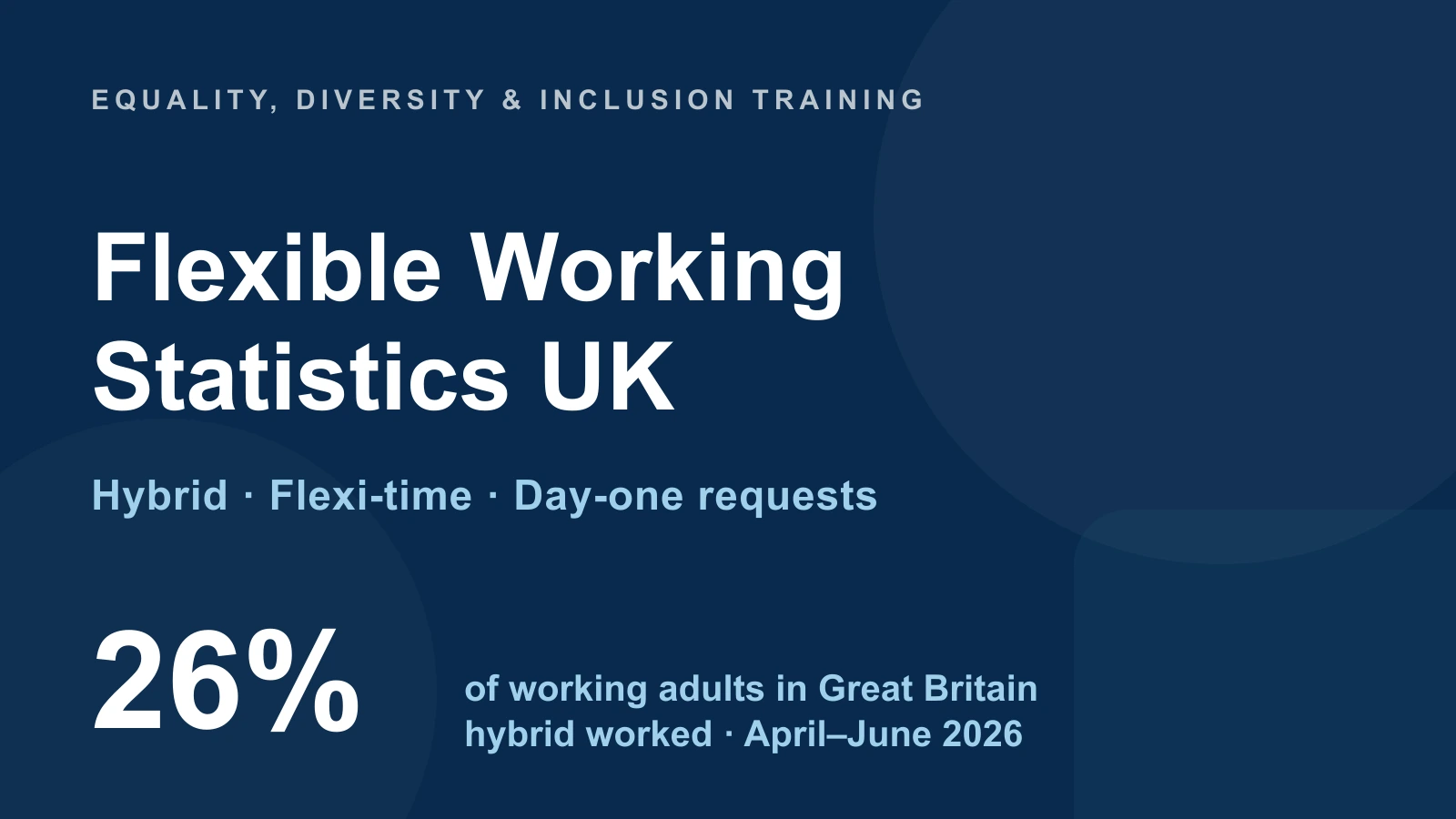
Flexible working includes changes to hours, schedules and work location. This guide brings together current ONS working-arrangement estimates, clearly dated employer research and the statutory request process in Great Britain. Each measure has its own population and period.
Key facts and figures
- 26% of working adults in Great Britain combined home working and travelling to work in the previous week (ONS, April–June 2026).
- 91% of employers surveyed offered some flexibility (CIPD, 2025).
- 38% of employees surveyed used flexi-time (CIPD, 2025).
- 40% versus 5% hybrid working among degree-holders and people without qualifications (ONS, April–June 2026).
- 41% hybrid working among professional occupations (ONS, April–June 2026).
- Day one statutory right to request flexibility for employees in Great Britain since 6 April 2024.
- 18% of employers surveyed reported more requests following the reform (CIPD, 2025).
- 3% of employees surveyed had left a job for lack of flexibility in the previous year (CIPD, 2025).
Reviewed on 15 October 2026. ONS describes working arrangements; the separate CIPD employer and employee surveys describe provision and experiences. Their percentages have different denominators.
What percentage of UK workers work flexibly or hybrid?
ONS estimated that 26% of working adults in Great Britain both worked from home and travelled to work in the previous seven days, using responses collected from 1 April to 28 June 2026. A further 14% worked from home without travelling to work. These are weekly activity measures, not counts of contractual rights.
Flexible working also covers changes to hours and schedules. An employer offering an arrangement does not mean every employee can use it, and a single quarterly estimate does not establish a long-term trend.
How many people have flexi-time contracts?
Flexi-time usually lets employees vary their start and finish times within agreed limits. In the CIPD’s 2025 employee survey, 38% said they used it. That survey percentage is not a national count of flexi-time contracts.
The measures below describe different aspects of flexibility and should not be added together.
| Measure | Figure | Period / source |
|---|---|---|
| Employees surveyed using flexi-time | 38% | CIPD, 2025 |
| Working adults combining home and workplace | 26% | Great Britain, April–June 2026; ONS |
| Employers surveyed offering flexibility | 91% | CIPD, 2025 |
| Employers surveyed with hybrid arrangements | 74% | CIPD, 2025 |
| Organisations requiring minimum attendance | 65% | CIPD, 2025 |
Which workers actually get to work hybrid?
The latest ONS table shows substantial differences by qualification and occupation. Hybrid working was reported by 40% of degree-holders, compared with 5% of those with no qualifications. The rate was 41% in professional occupations and 8% in skilled trades.
The estimates for disabled and non-disabled working adults were 24% and 27%. Their confidence intervals overlap, so this table does not establish a statistically significant disability difference. It also does not identify why someone works in a particular way.
| Group | Hybrid working, April–June 2026 |
|---|---|
| Degree or equivalent | 40% |
| No qualifications | 5% |
| Professional occupations | 41% |
| Skilled trades occupations | 8% |
| Non-disabled working adults | 27% |
| Disabled working adults | 24% |
ONS Opinions and Lifestyle Survey, Great Britain. “Working” includes paid work and some unpaid or voluntary work; estimates are rounded and subject to sampling uncertainty.
Who has the legal right to request flexible working?
Since 6 April 2024, employees in Great Britain can make a statutory flexible-working request from their first day of employment. Northern Ireland has separate rules. The right is to request a change, rather than to have every proposed arrangement approved.
An employee can make two statutory requests in 12 months. Employers must handle them reasonably, consult before rejecting a request and normally decide within two months, including any appeal. Refusal must rely on a statutory business reason. Further reforms under the Employment Rights Act 2025 are scheduled for 2027 and are not yet the current procedure.
Equality Act duties apply separately. A refusal may raise indirect discrimination or reasonable-adjustment issues depending on the circumstances; complying with the request procedure alone does not settle those questions.
How have flexible working requests changed since the day-one right?
CIPD’s 2025 survey found that 18% of employers had seen more requests since the day-one reform. It did not provide a national administrative count of requests.
In the employee survey, 30% felt uncomfortable requesting a formal change and 31% felt uncomfortable asking informally. These findings describe reported confidence, rather than proving why requests were or were not made.
Are employers pulling back to the office?
CIPD reported hybrid arrangements at 74% of surveyed organisations in 2025, compared with 84% in its similar 2023 survey. Among employers allowing hybrid work, 14% planned to introduce or increase required attendance. These are employer survey findings, not a census of office workers.
The same research estimated that the 3% who reported leaving a job for lack of flexibility represented about 1.1 million employees. This is a survey-based extrapolation about the preceding year, not a verified count of resignations in 2026.
How many jobs are advertised as flexible?
Timewise’s 2023 Flexible Jobs Index found that 31% of adverts offered flexibility, compared with 30% in 2022. This remains useful dated recruitment evidence; it should not be presented as a 2026 vacancy rate.
Stating available hours, location and other flexibility in an advert helps candidates decide whether a role could work for them. The advert measure differs from surveys asking whether an organisation offers any flexibility to existing staff.
Which groups most rely on flexible working?
Flexibility can help people combine work with caring responsibilities or manage a health condition. The useful arrangement varies: predictable shifts or different hours may matter where working from home is impractical.
Employers should consider the individual request and any separate equality duties, rather than assuming that everyone in a demographic group needs the same arrangement. See our guides to the disability employment gap, menopause at work and shared parental leave for their distinct evidence.
Frequently asked questions
What percentage of workers work hybrid?
ONS estimated 26% of working adults in Great Britain combined home working and travelling to work in the previous week in April–June 2026. This is a survey activity measure.
How many flexible-working requests have been made?
There is no single national count in the sources used here. CIPD’s 2025 survey found that 18% of employers reported an increase after the day-one reform.
Who has the legal right to request flexible working?
Employees in Great Britain have a day-one statutory right to request it. Normally, two requests can be made in 12 months and a decision is due within two months. Northern Ireland has separate rules.
Who can benefit from flexible working?
Different hours, schedules or locations can help people with caring responsibilities or health conditions, as well as other workers. The appropriate arrangement depends on the role and person.
How common is flexi-time?
38% of employees in CIPD’s 2025 survey said they used flexi-time. This is not a count of contractual arrangements across the UK.
Are employers reducing hybrid working?
CIPD’s comparable employer surveys recorded a lower share offering it in 2025 than in 2023. That does not establish that every sector or employee group experienced the same change.
Related guides
- Disability Employment Gap Statistics UK
- Menopause in the Workplace Statistics UK
- Shared Parental Leave & Paternity Statistics UK
- Reasonable Adjustments Under the Equality Act 2010
- Equality Act 2010: The Complete UK Guide
Sources & references
- ONS working arrangements by personal characteristics: April–June 2026
- CIPD: Flexible and hybrid working practices in 2025
- Timewise Flexible Jobs Index 2023
- Acas: statutory flexible-working requests
- Government implementation timeline: future flexible-working reforms
Flexible working, reasonable adjustments and the right to request all sit within the Equality Act 2010 — make sure your managers and HR team handle requests fairly and confidently.
Explore the Equality, Diversity & Inclusion course →
Mark writes about equality, diversity and inclusion, UK workplace compliance and accredited online training for Equality, Diversity & Inclusion Training, part of Online CPD Academy.