
This guide brings together dated UK research on menopause and employment, including CIPD’s 2023 survey, Fawcett’s 2022 survey and DWP’s 2025 evidence review. It distinguishes survey experiences from modelled economic costs and explains the legal position as at 15 October 2026.
Key facts and figures
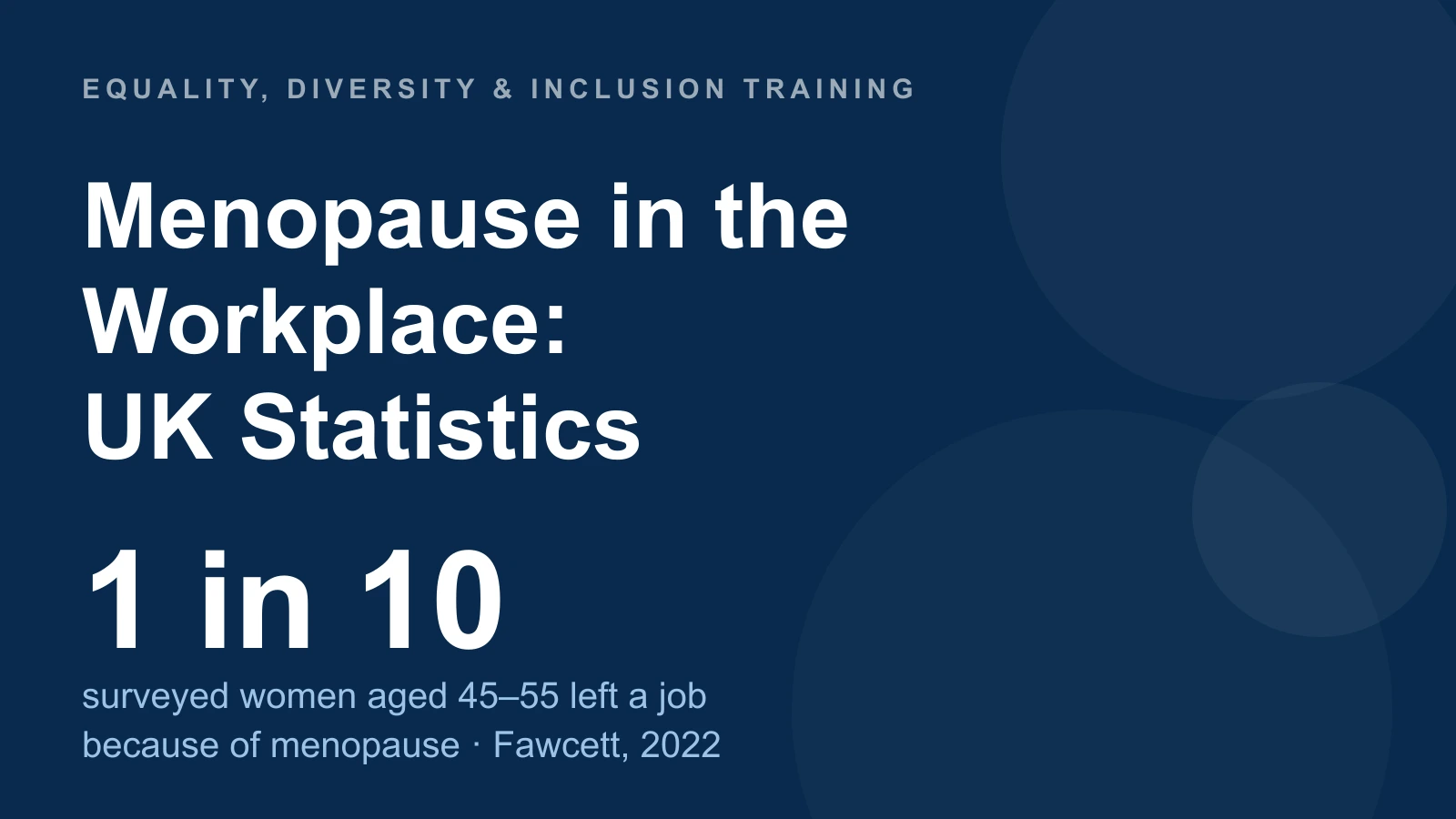
- 1 in 10 women who had worked during menopause reported leaving a job because of symptoms in Fawcett’s 2022 survey.
- 67% of symptomatic employed women aged 40–60 said symptoms mostly affected them negatively at work, CIPD 2023.
- 53% of symptomatic employed women aged 40–60 recalled being unable to attend work because of symptoms, CIPD 2023.
- £1.5 billion potential annual economic gain from employment in a 2024 model reviewed by DWP; not a current measured loss.
- 60,000 UK women estimated to be outside employment because of menopause in that 2024 model.
- 24% of employed women aged 40–60 reported a menopause policy or other employer support, CIPD 2023.
- 4.6 million economically active UK women aged 50–64 in 2024; an age-group context figure, not a count with symptoms.
- Spring 2027 planned mandatory equality action plans for large employers, subject to secondary legislation; voluntary in 2026.
Reviewed 15 October 2026. Survey results, modelled costs and future legal milestones are labelled separately; older research is not presented as a new 2026 survey.
How many working women in the UK are affected by the menopause?
DWP’s 2025 review cites around 4.6 million economically active women aged 50–64 in the UK in 2024. Economically active includes people in employment and people meeting the unemployment definition. This age-band count does not identify how many were experiencing menopause symptoms.
The NHS explains that menopause usually occurs between ages 45 and 55, but it can happen earlier. Symptoms and their effects vary. In CIPD’s 2023 survey of 2,185 employed women aged 40–60, 73% reported having experienced symptoms related to menopause transition.
How much menopause-related absence is there?
In CIPD’s May–June 2023 survey, 53% of employed women aged 40–60 who had experienced menopause symptoms could recall a time when those symptoms prevented them attending work. This is an ever-experienced measure, not the proportion absent in a particular year or a count of days lost.
DWP’s July 2025 review reports a 2024 economic model estimating annual absenteeism costs of £191 million and presenteeism costs of £22.4 million. These are modelled impacts with data and assumption limitations, rather than totals recorded by employers.
Disclosure can affect what an employer sees in absence records. The survey found that some respondents had not told managers about menopause or their symptoms. It does not establish how much national absence is missing from administrative records.
How do menopause symptoms affect women at work?
CIPD found that 67% of symptomatic employed women aged 40–60 reported a mostly negative effect at work in 2023. Among the narrower group who had been negatively affected, 79% reported difficulty concentrating and 68% increased stress. Those two percentages do not apply to every woman surveyed.
Among respondents who had experienced symptoms, 27% reported a negative impact on career progression. CIPD estimated this represented about 1.2 million employed women using 2022 population data. That extrapolation is historical and is not a count of tribunal findings or a current census.
How many women leave work because of the menopause?
Fawcett’s 2022 survey of 4,014 women aged 45–55 found that one in ten who had been employed during menopause had left a job because of symptoms. Fourteen per cent had reduced hours and 14% had moved to part-time work. These categories can overlap.
CIPD’s separate 2023 survey found 17% of symptomatic respondents had considered leaving because of a lack of support and 6% had left. Leaving a particular job is different from remaining outside employment, which is the outcome used in the economic model below.
| Measure | Figure | Source and period |
|---|---|---|
| Left a job because of symptoms | 1 in 10 | Fawcett survey, 2022 |
| Reduced working hours | 14% | Fawcett survey, 2022 |
| Moved to part-time work | 14% | Fawcett survey, 2022 |
| Considered leaving over lack of support | 17% | CIPD survey, 2023 |
| Had left over lack of support | 6% | CIPD survey, 2023 |
| Women outside employment attributed to menopause | About 60,000 | 2024 model reviewed by DWP in 2025 |
| Potential annual employment-related economic gain | About £1.5 billion | 2024 model reviewed by DWP in 2025 |
These studies use different samples and questions. They should not be combined into a single sequence in which women necessarily reduce hours and then leave employment.
What does the menopause cost the UK economy?
A 2024 report commissioned by the NHS Confederation estimated that around 60,000 UK women were outside employment because of perimenopause or menopause. Using average wages, it modelled an approximately £1.5 billion annual direct economic benefit if those women returned to employment. DWP discussed this estimate in its 2025 literature review.
The review found only two publications addressing economic costs and highlighted substantial evidence gaps. The main model extrapolated from a cohort aged 46–48 to ages 45–55 and used wage assumptions. Its £1.5 billion employment estimate, £191 million absence estimate and £22.4 million presenteeism estimate should be cited as modelled results with those limitations, not a verified current annual bill.
How much employer support is actually in place?
In CIPD’s 2023 survey, 24% of employed women aged 40–60 said their organisation had a menopause policy or other support. This measures employees’ reported awareness; it is not a representative count of the proportion of all UK employers with a policy.
DWP’s review found limited evidence about the reach and effectiveness of employer support. Smaller studies and different questions do not provide reliable current league tables of support by industry. Practical support should respond to individual needs and be reviewed with the employee.
Government published a voluntary action-plan framework in 2026. This provides options for employers alongside duties that already apply under equality and health-and-safety law.
Is menopause a disability under the Equality Act 2010?
Menopause is not itself a protected characteristic under the Equality Act 2010, which applies in Great Britain. Depending on the facts, treatment connected with menopause can engage sex, age or disability protections. Symptoms can meet the disability definition where their effect on normal day-to-day activities is substantial and long term.
EHRC guidance explains the resulting reasonable-adjustment duty and protections against discrimination. Menopause does not automatically establish a disability, and not every workplace difficulty is unlawful discrimination. Northern Ireland has a separate equality-law framework.
What are menopause action plans and when do they become mandatory?
As at 15 October 2026, the government’s equality action-plan framework is voluntary for employers with 250 or more employees. It covers reducing gender pay gaps and supporting employees experiencing menopause. Guidance offers 18 actions and asks participating employers to select at least two new or ongoing actions, including at least one on each theme.
The government plans to make action plans mandatory in spring 2027, subject to secondary legislation. That is a future implementation plan, not a duty already in force. The guidance has separate scope provisions for public bodies in Scotland and Wales.
Employers should use the published guidance and subsequent regulations for the final requirements and deadlines.
Frequently asked questions
How many working women are affected by menopause?
There is no single current workplace count. CIPD’s 2023 survey found symptoms had mostly affected work negatively for 67% of symptomatic employed women aged 40–60. The 4.6 million figure describes economically active women aged 50–64 in 2024, not diagnosed or symptomatic cases.
How many women leave a job because of symptoms?
Fawcett’s 2022 survey found one in ten women who had worked during menopause reported doing so. CIPD’s separate 2023 survey found 6% of symptomatic respondents had left because of insufficient support.
How much sick leave does menopause cause?
CIPD found 53% of symptomatic respondents could recall being unable to attend work. This does not measure annual days lost. The £191 million absence-cost figure is a 2024 model, reviewed by DWP in 2025.
Is menopause a disability under the Equality Act?
Not automatically. Symptoms may meet the substantial and long-term effect test; age and sex protections may also be relevant in Great Britain.
When do menopause action plans become mandatory?
The framework is voluntary in 2026. The government plans mandatory plans for large employers in spring 2027, subject to secondary legislation and final requirements.
Do most employers have a menopause policy?
The cited survey cannot count all employers. In 2023, 24% of employed women aged 40–60 reported a menopause policy or other support at their organisation.
Related guides
- Women in Leadership Statistics UK
- Workplace Discrimination Statistics UK: Tribunal Claims, Prevalence & Protected Characteristics
- Maternity Discrimination Statistics UK
- Disability Employment Gap Statistics UK
- Reasonable Adjustments Under the Equality Act 2010: A UK Employer’s Guide
- Equality Act 2010: The Complete UK Guide
Sources & references
- CIPD — Menopause in the workplace: employee experiences in 2023
- Fawcett Society — Menopause and the Workplace, 2022
- DWP — Menopause in the Workplace Literature Review, 2025; evidence to October 2024
- EHRC — Menopause in the workplace: guidance for employers
- Government — Creating an action plan: 2026 voluntary framework
- Government — Action plans: choose your actions
- Government — Employment Rights Act implementation timeline, September 2026
- NHS — Menopause
Menopause support is about to become a legal expectation for large employers — train your team on the Equality Act 2010 and inclusive workplace practice before the 2027 action-plan duty lands.
Explore the Equality, Diversity & Inclusion course →
Mark writes about equality, diversity and inclusion, UK workplace compliance and accredited online training for Equality, Diversity & Inclusion Training, part of Online CPD Academy.