
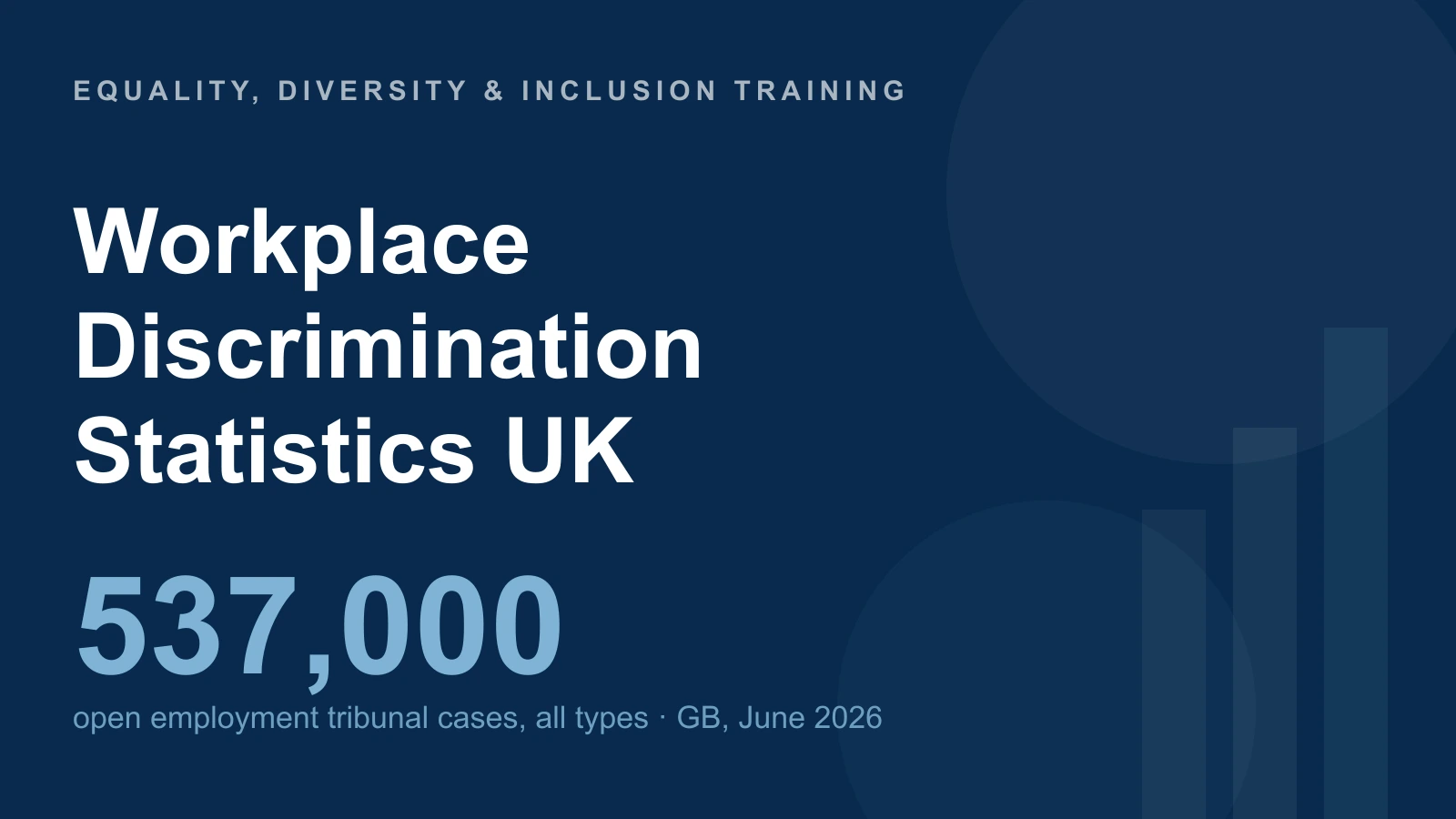
This guide separates official employment-dispute statistics from surveys of reported discrimination. The latest tribunal activity covers April–June 2026, Acas figures cover 2025/26, and the historical award data have narrower coverage.
Key facts and figures
- 537,000 open employment tribunal claims at the end of June 2026, all jurisdictions combined, GB.
- 4,051 disability-discrimination complaints received in Reform single cases, April–June 2026, provisional.
- 25,000 total tribunal claim receipts versus about 10,000 disposals in April–June 2026, GB.
- 150,000+ early-conciliation notifications handled by Acas in 2025/26, up 27%.
- £53,403 mean sex-discrimination award in the 2023/24 legacy-system data; not a current all-case average.
- £995,128 highest discrimination award in those 2023/24 legacy-system tables, for sex discrimination.
- 45% of UK adults surveyed by Ciphr in 2025 reported discrimination at work or while job hunting at some point.
- 19% reported age discrimination in that survey, its most commonly selected type.
Reviewed 15 October 2026. Official case counts and self-reported survey experience have different meanings. Annual award statistics remain suspended while MoJ combines case-management data.
How many discrimination claims reach employment tribunals?
At the end of June 2026, employment tribunals in Great Britain had about 537,000 open claims: 70,000 single claims and 467,000 multiple claims. These totals cover all employment jurisdictions, not just discrimination. Multiple claims can contain many linked claims against one employer.
In April–June 2026 there were about 25,000 receipts and 10,000 disposals. These are rounded figures. MoJ has revised the combined legacy and Reform totals and warns that open single and lead-multiple cases may still be overcounted by approximately 3%.
A claim may include several jurisdictional complaints. The detailed jurisdiction tables currently cover only single cases on the Reform system; they cannot be treated as a complete breakdown of the combined caseload or as unique claimants.
Why are disability discrimination claims rising so fast?
The provisional April–June 2026 Reform single-case table recorded 4,051 disability-discrimination jurisdictional complaints received. The revised total for 2025/26 was 13,246. These are allegations received, not successful claims or unique people.
Disability discrimination includes several legal routes, such as a failure to make reasonable adjustments and discrimination arising from disability. These data alone do not identify why claims were brought or prove that awareness, flexible working or any particular condition caused a change.
The Reform system was introduced progressively from 2022. Early figures cover a changing share of cases, so apparent growth over that rollout should not be presented as a like-for-like national trend.
How much do tribunals award for discrimination?
MoJ’s historical 2023/24 tables cover legacy-system cases only; they exclude cases recorded in the newer Reform system. Within that coverage, the mean sex-discrimination award was £53,403 and the mean race-discrimination award £29,532. Age discrimination had the largest mean, £102,891.
The highest discrimination award in those tables was £995,128 for sex discrimination. A corrected judgment moved this award into 2023/24 and revised the previous year. Large awards can strongly affect means, so these figures are not forecasts of a typical settlement.
| Measure | Figure, 2023/24 | Coverage / interpretation |
|---|---|---|
| Mean sex-discrimination award | £53,403 | Legacy system only; excludes Reform cases |
| Mean race-discrimination award | £29,532 | Legacy system only; excludes Reform cases |
| Mean age-discrimination award | £102,891 | Highest mean among these discrimination categories |
| Highest discrimination award | £995,128 | Sex-discrimination case; corrected judgment |
| Statutory discrimination compensation cap | None | Award depends on proven claim and loss |
As of the September 2026 release, MoJ has suspended annual compensation statistics pending extraction and quality assurance of combined data. There is no confirmed next publication date to promise.
How many disputes does Acas resolve before tribunal?
Acas handled over 150,000 early-conciliation notifications in 2025/26, 27% more than the previous year. It reported resolving more than nine in ten cases handled. These are service measures across employment disputes, not a count of discrimination findings or tribunal awards.
Most prospective tribunal claimants must notify Acas first, although exceptions exist. Taking part in conciliation is voluntary. Timely notification affects the claim deadline; using an internal grievance procedure does not itself stop the clock.
For most claims concerning a problem on or after 1 October 2026, the initial limit is six months minus one day. For problems before that date, it is usually three months minus one day. Exceptions and conciliation extensions can change the deadline, so the applicable dates should be checked promptly.
How common is workplace discrimination in the UK?
Ciphr’s February 2025 survey of 4,000 UK adults found that 45% reported discrimination at work or while applying for jobs at some point. Nineteen per cent reported age discrimination, the most frequently selected type in that survey. These are self-reported lifetime experiences, not the proportion discriminated against during 2025.
Survey questions can include experiences broader than legally established discrimination. Respondents may select more than one type. Survey percentages cannot be converted directly into tribunal success rates or the number of unreported legal claims.
Which protected characteristics see the most discrimination?
In MoJ’s provisional April–June 2026 Reform single-case receipt table, selected jurisdictional complaint counts were:
- Disability: 4,051.
- Race: 1,411.
- Sex: 1,239; this table category also includes marriage and civil partnership and gender reassignment.
- Age: 633.
- Religion or belief: 350.
- Sexual orientation: 186.
These categories are not a one-to-one list of the nine protected characteristics and are not mutually exclusive people. Sexual-harassment survey evidence and the employer’s preventative duty are covered in our separate guide.
Frequently asked questions
How many discrimination claims reach employment tribunals?
There is no single all-system total in the latest jurisdiction breakdown. It covers Reform single cases: for April–June 2026, disability complaints numbered 4,051 and race complaints 1,411, provisionally. The 537,000 open-claim total covers all jurisdictions.
What is the average discrimination award?
Historical 2023/24 legacy-system means were £53,403 for sex discrimination and £29,532 for race discrimination. These exclude Reform cases and are not current typical payouts; later annual award publication is suspended.
What type of discrimination is most commonly reported?
Age was the most frequently selected type in Ciphr’s 2025 survey, reported by 19% of its UK adult respondents. Survey rankings need not match tribunal complaint rankings.
What does the race-discrimination evidence show?
Ciphr’s 2025 survey found 9.3% of all UK adult respondents reported race discrimination at work or in job hunting. MoJ recorded 1,411 race-discrimination complaints in Reform single cases in April–June 2026; these measures have different populations.
Are discrimination awards capped?
There is no statutory upper cap on discrimination compensation. The amount depends on the proven claim and losses, including injury to feelings where appropriate.
Where do the figures come from?
MoJ publishes tribunal activity, Acas publishes conciliation service data, and surveys measure reported experiences. Their coverage and time periods should always accompany the figures.
Related guides
- Sexual Harassment at Work Statistics UK: Prevalence, Reporting Rates & the New Preventative Duty
- Neurodiversity Statistics UK: Autism, ADHD & Dyslexia Prevalence and Employment
- Equality Act 2010: The Complete UK Guide
- The Nine Protected Characteristics Under the Equality Act 2010
- Reasonable Adjustments Under the Equality Act 2010: A UK Employer’s Guide
Sources & references
- MoJ — Tribunal statistics, April–June 2026, including data-quality notes
- MoJ — 2023/24 annual employment tribunal award tables E_4 to E_9
- Acas — Annual report results, 2025/26
- Acas — Employment tribunal time limits, October 2026
- Acas — Early conciliation
- Ciphr — Survey of 4,000 UK adults, February 2025
The best discrimination claim is the one that never happens — train your team on the Equality Act 2010 and their day-to-day responsibilities.
Explore the Equality, Diversity & Inclusion course →
Mark writes about equality, diversity and inclusion, UK workplace compliance and accredited online training for Equality, Diversity & Inclusion Training, part of Online CPD Academy.