
This page brings together surveys about sexual harassment and work-related experiences, with the population and period shown for each figure. It also explains the employer duty in Great Britain as at 15 October 2026 and the changes due to take effect on 30 October 2026.
Key facts and figures
- Over 6,000 female Unite members took part in its survey across 19 sectors.
- 25% of Unite respondents reported sexual assault in the work-related settings covered by the survey.
- 56% reported sexually offensive jokes in the Unite survey.
- 43% reported inappropriate touching in the Unite survey.
- 58% of working women in a 2023 TUC poll reported sexual harassment, bullying or verbal abuse at work.
- 62% of women aged 25–34 reported that combined measure in the same TUC poll.
- 68% of LGBT respondents in the TUC’s historical 2019 survey reported sexual harassment at work.
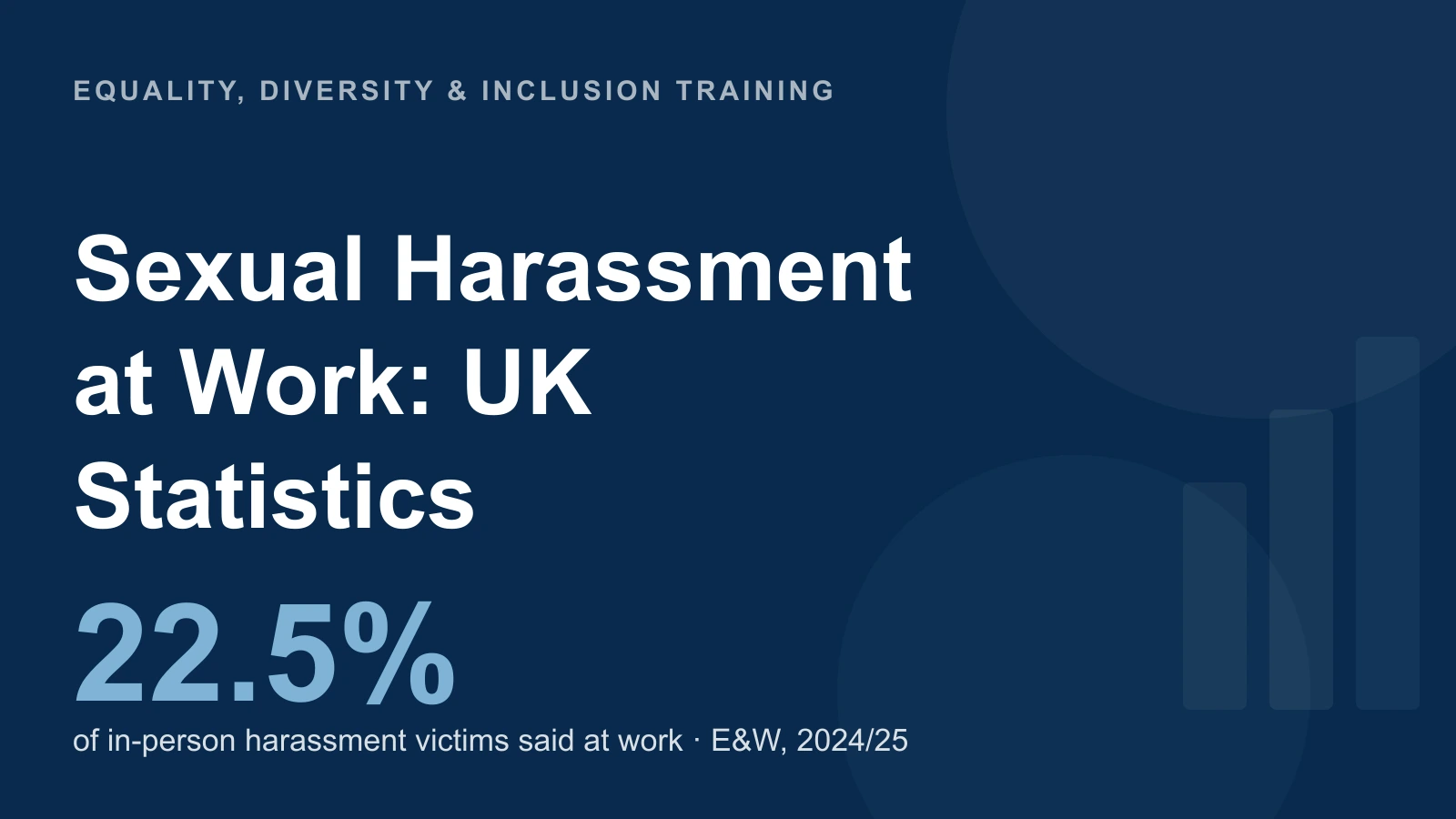
- 22.5% of people who experienced in-person sexual harassment said it happened at work, CSEW year ending March 2025.
Reviewed 15 October 2026. Union surveys describe their respondents; the Crime Survey for England and Wales uses a different population and reference period. None of these measures is a single current UK workplace prevalence rate.
Sexual harassment statistics at a glance
The measures below use different questions and samples. The TUC’s combined harassment, bullying or verbal-abuse measure must not be relabelled as sexual harassment alone.
| Measure | Figure | Source and population |
|---|---|---|
| Unite survey sample | Over 6,000 women | Female union members; campaign findings |
| Sexual assault reported | 25% | Unite female-member sample |
| Sexually offensive jokes | 56% | Unite female-member sample |
| Inappropriate touching | 43% | Unite female-member sample |
| Sexual harassment, bullying or verbal abuse | 58% | TUC working women poll, April 2023 |
| Combined measure among women aged 25–34 | 62% | TUC poll, April 2023 |
| Sexual harassment among LGBT respondents | 68% | TUC survey, 2019 |
| Workplace setting among those experiencing in-person sexual harassment | 22.5% | CSEW England and Wales, year ending March 2025 |
How many women experience sexual harassment at work?
Unite’s published campaign findings describe a survey of over 6,000 female members across 19 sectors. It asked about sexual harassment at work, while travelling to work, or by a colleague during or outside working hours. Reported experiences included sexual assault (25%), sexually offensive jokes (56%), unwanted flirting, gestures or sexual remarks (55%), inappropriate touching (43%) and being shown or sent pornography (28%).
These figures describe participating union members and overlapping experiences; they should not be added together or treated as a representative estimate for all women in the UK.
The TUC’s April 2023 poll of 1,010 working women found 58% had experienced sexual harassment, bullying or verbal abuse at work. This broader combined question produced 62% among women aged 25–34. It does not isolate sexual harassment prevalence.
Who is most at risk of sexual harassment at work?
The TUC’s 2019 survey of more than 1,000 LGBT respondents found 68% reported sexual harassment at work. It provides historical evidence about that sample, rather than a current ranking of risk across all protected groups. Differences between surveys prevent a reliable league table of who is most affected.
For a different perspective, government consultation evidence citing the Crime Survey for England and Wales reports that 22.5% of people aged 16 and over who experienced in-person sexual harassment in the year ending March 2025 said it happened at work. That is a setting among people who experienced harassment, not the percentage of workers harassed.
Employers should consider how factors such as job role, power imbalances, isolation, customer contact and barriers to reporting affect their own risk assessment, without assuming that only one group can experience sexual harassment.
How many people report sexual harassment at work?
In the TUC’s 2019 LGBT survey, about two-thirds of respondents who had been sexually harassed did not report it to their employer. Among those who did not report, one in four cited fear of being outed. These are historical findings with specific denominators, not a universal non-reporting rate for all workers.
Reporting can depend on confidence in the procedure, fear of retaliation, confidentiality and whether workers expect action. Employers should offer accessible reporting routes, explain how concerns will be handled and review whether workers trust those arrangements. A low number of complaints does not demonstrate that harassment is absent.
What counts as sexual harassment at work?
Section 26(2) of the Equality Act 2010 defines sexual harassment as unwanted conduct of a sexual nature with the purpose or effect of violating dignity or creating an intimidating, hostile, degrading, humiliating or offensive environment. Examples can include sexual comments, unwelcome touching, sexual advances and explicit messages or images. The Act applies in Great Britain.
An intention to harass is not required. When deciding whether conduct had the prohibited effect, the law considers the person’s perception, the other circumstances and whether it was reasonable for the conduct to have that effect.
Survey questions and legal findings are different. A respondent’s reported experience is not a tribunal determination, and a question combining bullying, verbal abuse and sexual harassment cannot provide a sexual-harassment-only rate.
What do tribunal and Acas figures show?
Employment tribunal statistics, helpline enquiries and population surveys measure different things. A published-judgment count can omit claims settled or resolved without a published judgment; helpline contacts are not necessarily unique incidents or successful claims. They should not be divided into survey prevalence estimates to calculate a reporting or litigation rate.
Where a tribunal upholds a sexual harassment claim and finds that the employer breached the preventative duty, it can increase compensation by up to 25%. The uplift is not automatically payable whenever harassment is alleged, and the preventative duty does not create a standalone individual tribunal claim.
For most tribunal claims concerning events before 1 October 2026, the usual limit was three months minus one day. For events on or after 1 October 2026, most limits are six months minus one day. Exceptions apply; timely notification to Acas can pause the clock, whereas an internal grievance does not. Check the relevant deadline promptly.
What is the employer duty to prevent sexual harassment?
Since 26 October 2024, employers in Great Britain have had a duty to take reasonable steps to prevent sexual harassment of workers. This is the standard in force on this page’s review date, 15 October 2026. Employers should assess foreseeable risks and act on them, including risks involving customers or other third parties.
From 30 October 2026, the Employment Rights Act 2025 strengthens the duty to all reasonable steps and introduces employer liability for third-party harassment where the relevant conditions are met. These changes are forthcoming as of the review date.
Practical prevention includes an effective policy, risk assessment, appropriate training, reporting routes, action on complaints and monitoring. A consultation about future regulations is not itself a binding checklist of prescribed steps. The EHRC can enforce the preventative duty; a tribunal can apply the conditional compensation uplift described above.
Frequently asked questions
What percentage of women experience sexual harassment at work?
There is no single interchangeable figure across these studies. The TUC’s 2023 working-women poll found 58% reported sexual harassment, bullying or verbal abuse combined. Unite’s female-member survey reports specific behaviours and covers work-related settings beyond the workplace.
How many people report sexual harassment?
In the historical TUC 2019 LGBT survey, about two-thirds of those harassed did not report it to their employer. This cannot be generalised into one reporting rate for all UK workers.
What did the TUC LGBT survey find?
68% of respondents reported sexual harassment at work in its 2019 study. Among those who did not report harassment, one in four cited fear of being outed.
What is the employer’s current preventative duty?
On 15 October 2026, employers in Great Britain must take reasonable steps to prevent sexual harassment. The duty has applied since 26 October 2024.
What changes on 30 October 2026?
The standard becomes all reasonable steps, and new third-party harassment liability takes effect where its conditions are met. These changes are not yet in force on the review date.
When can compensation rise by up to 25%?
Where a tribunal upholds a sexual harassment claim and finds a breach of the employer’s preventative duty. The increase is conditional, not automatic.
Related guides
- Workplace Discrimination Statistics UK: Tribunal Claims, Prevalence & Protected Characteristics
- Neurodiversity Statistics UK: Autism, ADHD & Dyslexia Prevalence and Employment
- Equality Act 2010: The Complete UK Guide
- The Nine Protected Characteristics Under the Equality Act 2010
- How to Write an Equality and Diversity Policy: A UK Guide
Sources & references
- Unite — Survey of over 6,000 female members, campaign findings
- TUC — Working women poll, April 2023
- TUC — Sexual harassment of LGBT people in the workplace, 2019
- Government consultation, January 2026 — CSEW year ending March 2025 evidence
- Equality Act 2010, section 26
- Acas — Sexual harassment and the employer’s preventative duty
- Acas — Harassment law changes from 30 October 2026
- Acas — All reasonable steps from 30 October 2026
- Acas — Tribunal time limits, including changes from 1 October 2026
Training is one of the core reasonable steps the EHRC expects employers to take to prevent harassment — get your team certified.
Explore the Equality, Diversity & Inclusion course →
Mark writes about equality, diversity and inclusion, UK workplace compliance and accredited online training for Equality, Diversity & Inclusion Training, part of Online CPD Academy.