
This guide separates estimates of neurodivergence from employment rates, NHS referrals, survey screening and workplace experiences. It was reviewed on 15 October 2026 against official statistics and the original research, with each measure’s period and population stated.
Key facts and figures
- Around 1 in 7 is a commonly cited estimate of neurodivergence, not an official aggregate UK prevalence statistic.
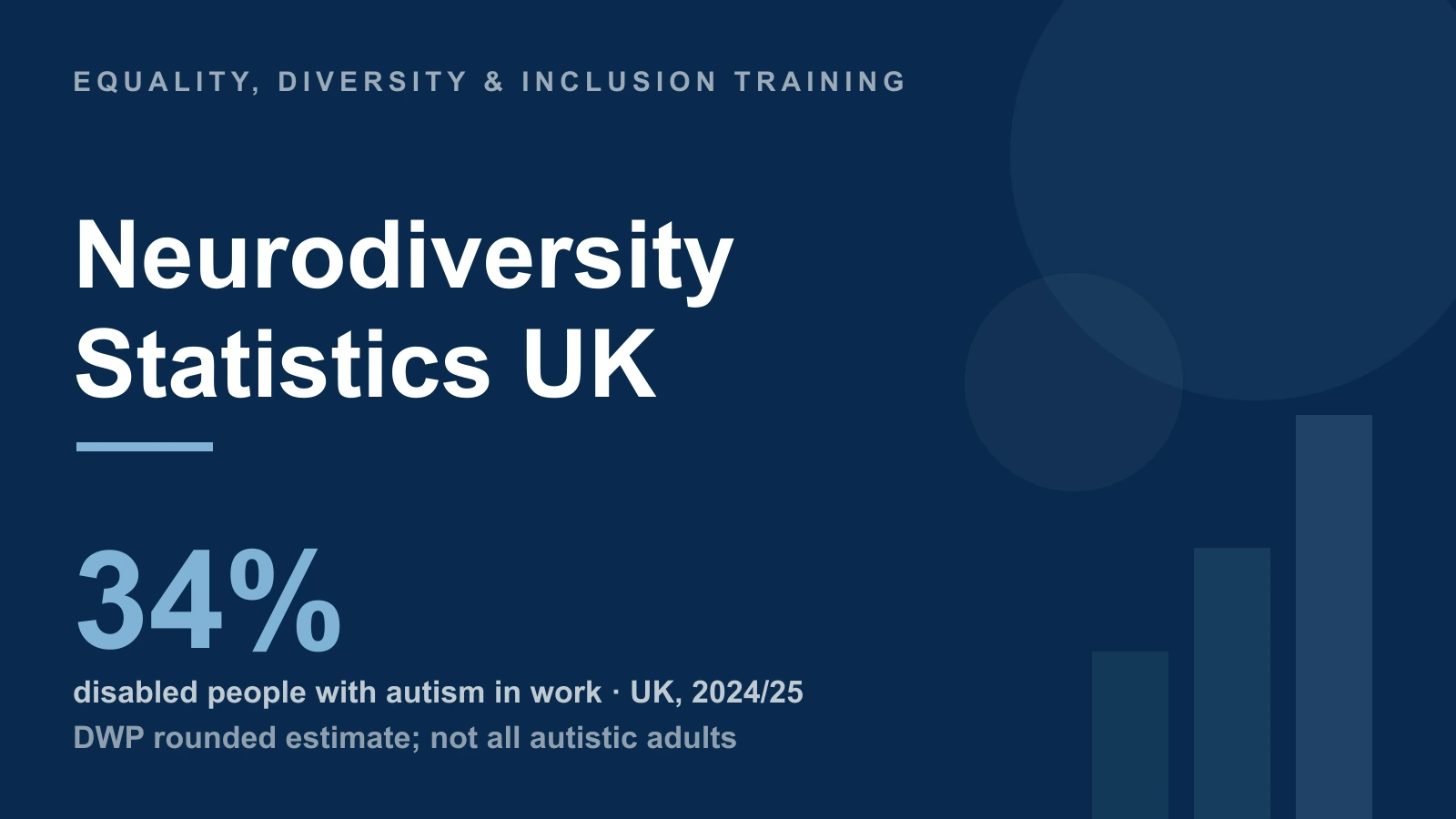
- 34% employment among disabled people with autism in 2024/25, compared with about 55% of disabled people overall, DWP.
- 294,792 patients had an open suspected-autism referral in NHS England’s reporting system in June 2026.
- 13.9% of adults in England screened positive for possible ADHD in 2023/24; 1.8% reported a professional diagnosis. Screening is not diagnosis.
- About 10% estimated dyslexia prevalence, British Dyslexia Association.
- 65% of neurodivergent employee respondents feared discrimination from management when disclosing, Birkbeck/NiB 2023.
- 517 neurodiversity-related tribunal cases identified for 2025 in Irwin Mitchell’s analysis, compared with 265 in 2020.
- 3.8% of UK Indeed postings contained neurodiversity-related keywords in December 2024; some advertised care roles.
Reviewed 15 October 2026. Estimates, survey screening, referrals and tribunal-record analysis are different measures; none is a complete count of neurodivergent people.
| Measure | Figure | Population and period |
|---|---|---|
| Estimated neurodivergent share | Around 1 in 7 | Common estimate; no ONS aggregate |
| Estimated dyslexia prevalence | About 10% | British Dyslexia Association estimate |
| Employment: disabled people with autism | 34% | UK, 2024/25, DWP rounded figure |
| Employment: all disabled people | About 55% | UK, 2024/25, DWP rounded figure |
| Employment: autism as main health condition | 31.4% | UK ages 16–64, 2024/25; narrower category |
| Patients with open suspected-autism referrals | 294,792 | England reporting system, June 2026 |
| Positive screen for possible ADHD | 13.9%; 1.8% reported diagnosis | England adults in private households, 2023/24 |
| Neurodiversity-related tribunal cases identified | 517 | Irwin Mitchell analysis of 2025 records |
How many people in the UK are neurodivergent?
Around one in seven is a commonly cited estimate, but definitions vary and conditions overlap. It should not be converted into a precise current count or treated as an official ONS statistic. In January 2026, ONS confirmed that it does not produce a single total for UK adults with one or more neurodivergent conditions.
ONS health-survey responses are self-reported, not clinical records. Condition-specific figures also measure different things: the British Dyslexia Association estimates around 10% dyslexia prevalence, while the NHS-commissioned ADHD Taskforce’s final summary cites research estimates of about 5% in children and 2–3% in adults. These percentages cannot be added together because people can have more than one condition.
What is the autism employment gap in the UK?
DWP’s October 2026 announcement reports that 34% of disabled people with autism were in work in 2024/25, compared with about 55% of disabled people overall. This is not an employment rate for every autistic adult, including those outside the survey’s disability definition.
The detailed annual publication gives 31.4% for disabled people aged 16–64 whose main health condition was autism. That narrower category differs from including autism as a secondary condition. Age, qualifications and co-occurring conditions also affect comparisons.
The Expert Academic Panel on Neurodiversity published its final report and recommendations on 2 October 2026. Its recommendations include support based on individual needs and better evidence about workplace practice; the panel is no longer merely awaiting its first findings.
How common is ADHD in the UK?
In England’s Adult Psychiatric Morbidity Survey 2023/24, 13.9% of adults aged 16+ living in private households screened positive for possible ADHD and 1.8% reported having received a professional diagnosis. A screening questionnaire identifies possible symptoms; it does not establish that every positive result meets diagnostic criteria.
The difference between these percentages is therefore not the proportion of adults with undiagnosed ADHD. NHS England’s ADHD Taskforce final summary, published in December 2025, cites broader research estimates of 2–3% in adults and about 5% in children. Its recommendations concern assessment and support, not treating a positive screen as a diagnosis.
At work, employers can discuss barriers and support without waiting for a diagnosis. Whether the Equality Act disability definition and adjustment duty apply depends on the individual circumstances.
How long are NHS autism assessment waiting lists?
NHS England reported 294,792 patients with an open referral for suspected autism in June 2026. Of these, 256,017, or 86.8%, had a referral open for at least 13 weeks. These are patients in the reporting system, not all autistic people or all UK assessment pathways.
An open referral can include someone who has already had an initial appointment. The 86.8% figure must not be described as the share still waiting for a first appointment beyond the recommended period. The release separately reports timing of first care contacts.
These statistics include relevant activity in the Mental Health Services Dataset but exclude community paediatric assessments that cannot yet be identified in the Community Services Dataset. Data-quality limitations also apply. Workplace support needs should be considered individually while assessment is pending.
Do neurodivergent employees feel safe to disclose at work?
In Birkbeck and Neurodiversity in Business’s 2023 survey of 990 neurodivergent employees and 127 employer representatives, 65% of employee respondents feared discrimination from management and 55% feared it from colleagues if they disclosed. These are survey responses, not prevalence estimates for every UK workplace.
The 2024 follow-up included 1,436 neurodivergent workers, 132 employer representatives and 123 neurotypical colleagues. It found 78% of neurodivergent participants felt overwhelmed at work. Different samples and measures should not be combined into a national trend without accounting for the research design.
Confidential conversations and a clear adjustments process can help employers identify individual needs. Neither population estimates nor a survey’s disclosure rate can establish how many employees in a particular organisation are neurodivergent.
Are neurodiversity employment tribunal claims rising?
Irwin Mitchell’s February 2026 analysis identified 517 tribunal cases linked to neurodivergent conditions in 2025, compared with 265 in 2020: an increase of about 95%. It reported an increase of almost 19% from 2024 to 2025. This is the law firm’s analysis of tribunal records, not a separate official MoJ neurodiversity jurisdiction.
The analysis reported 121 autism-related cases and 118 ADHD-related cases for 2025. Conditions may overlap. Counts of identified cases are not a measure of the proportion of workers discriminated against, successful claims or compensation awards.
The analysis does not establish which factors caused the increase. Disability-discrimination compensation has no statutory maximum, but an award depends on the findings and losses in the individual case. Wider jurisdiction statistics are discussed in our workplace discrimination statistics.
Are employers becoming more neuroinclusive?
Indeed Hiring Lab found neurodiversity-related keywords in 3.8% of UK postings on Indeed in December 2024, compared with around 1% in January 2018. Some postings were for roles supporting neurodivergent people, rather than statements welcoming neurodivergent applicants.
After excluding care-related occupational groups, the share rose from 0.2% to 2.6%. These figures describe wording in postings on one platform. They do not demonstrate how many neurodivergent applicants were hired or how inclusive their subsequent employment was.
Frequently asked questions
What percentage of the population is neurodivergent?
Around one in seven is a commonly used estimate. ONS does not produce a single UK adult total, and definitions and overlapping conditions limit precise comparisons.
How many autistic people are employed?
DWP reports 34% employment among disabled people with autism in 2024/25. The narrower category with autism as the main health condition had a 31.4% rate; these are not identical populations.
How common is ADHD in adults?
The NHS Taskforce cites research estimates of 2–3%. England’s 13.9% positive-screen result in APMS 2023/24 measures possible symptoms, not confirmed diagnoses; 1.8% reported a professional diagnosis.
How many people have dyslexia?
The British Dyslexia Association estimates around 10% of the population. It is an estimate, and people may also have other conditions.
Does the Equality Act cover neurodivergence?
In Great Britain, an impairment can meet the disability definition where its adverse effect on normal day-to-day activities is substantial and long term. A formal diagnosis is not itself the legal test. Employers must consider reasonable adjustments where the relevant duty applies.
Are neurodiversity tribunal cases increasing?
Irwin Mitchell identified 517 related cases in 2025 and 265 in 2020. Its analysis does not establish the causes of that increase or a national rate of discrimination.
The statistics on this page describe a workforce that is far more neurodiverse than most organisations realise, and a legal environment that increasingly expects employers to respond. The foundations are covered in our guides to the Equality Act 2010, the nine protected characteristics and neurodiversity at work. To give your team the practical understanding behind these numbers — inclusive everyday practice, disclosure-safe culture and the duty to make adjustments — our Equality, Diversity & Inclusion Training course covers neurodiversity as part of the full Equality Act framework.
Related guides
- Workplace Discrimination Statistics UK: Tribunal Claims, Prevalence & Protected Characteristics
- Sexual Harassment at Work Statistics UK: Prevalence, Reporting Rates & the New Preventative Duty
- Neurodiversity at Work: A UK Employer's Guide
- Reasonable Adjustments Under the Equality Act 2010: A UK Employer's Guide
- The Nine Protected Characteristics Under the Equality Act 2010
- Equality Act 2010: The Complete UK Guide
Sources & references
- DWP — Neurodiversity employment report announcement, 2 October 2026
- DWP — Employment of disabled people 2025, 2024/25 condition-level data
- NHS England — Autism Statistics, July 2025 to June 2026
- NHS England — APMS 2023/24, ADHD screening and diagnosis
- NHS England — ADHD Taskforce final report summary, December 2025
- Birkbeck — Neurodiversity at Work survey, March 2023
- Birkbeck — Neurodiversity in Business research, 2024
- Irwin Mitchell — Analysis of neurodiversity-related tribunal cases, February 2026
- Indeed Hiring Lab — UK neurodiversity-related job postings, February 2025
- ONS — Neurodivergence prevalence FOI response, January 2026
- British Dyslexia Association — What is dyslexia?
- Acas — Neurodiversity at work
Put the numbers into practice — train your team to support neurodivergent colleagues and meet Equality Act duties.
Explore the Equality, Diversity & Inclusion course →
Mark writes about equality, diversity and inclusion, workplace compliance and accredited online training for Equality, Diversity & Inclusion Training, part of Online CPD Academy.