
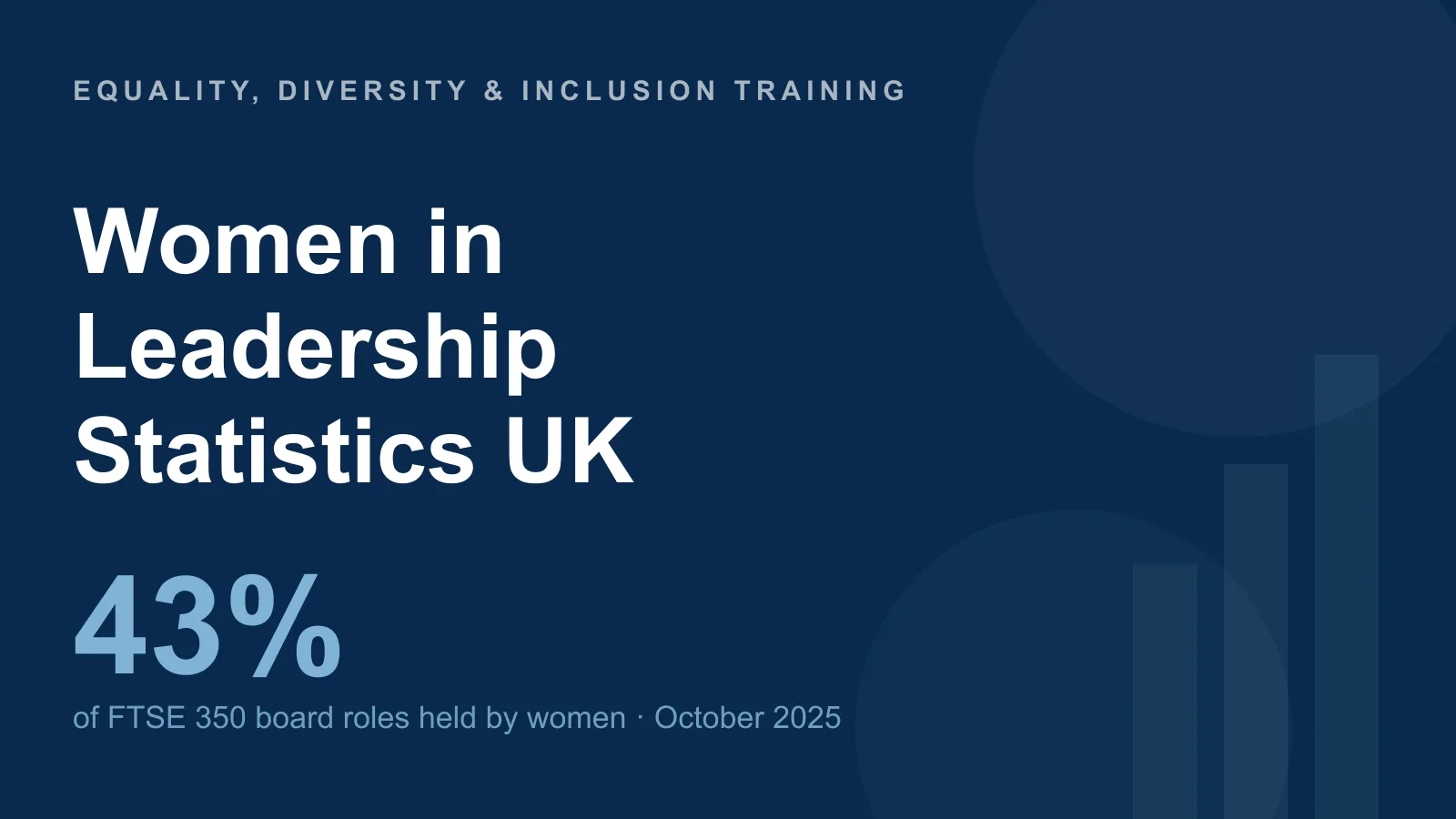
This guide compares women’s representation on major company boards, in executive roles and in selected public and private-sector leadership groups. Each figure has its own date and population; these measures describe representation rather than pay differences or a national share of all managers.
Key facts and figures
- 42.7% of FTSE 350 board roles were held by women in October 2025, compared with 9.5% in 2011.
- 44.4% of FTSE 100 directorships were held by women in October 2025.
- 21 women CEOs across the FTSE 350, including nine in the FTSE 100, October 2025.
- 15.4% versus 49.5% women among FTSE 350 executive directors and non-executive directors respectively.
- 35.9% of FTSE 350 leadership roles were held by women in October 2025.
- 82% of FTSE 350 companies had a woman in at least one of the four key roles, October 2025.
- 49.8% of Senior Civil Service staff were women at 31 March 2026.
- 263 women MPs were elected at the July 2024 general election, 40% of the Commons.
Reviewed 15 October 2026. Board, workforce and election figures have different reference dates and cover different populations.
What percentage of FTSE board positions are held by women?
The FTSE Women Leaders Review 2026 records women in 42.7% of FTSE 350 board roles and 44.4% of FTSE 100 directorships in October 2025. The FTSE 350 figure was 9.5% in 2011. These are shares of board positions, not of all employees or all British companies.
The review reports no all-male boards in the FTSE 350 since 2020. That milestone does not mean every board has equal representation or that women hold the same share of executive and non-executive positions.
Has the UK met the 40% women on boards target?
The FTSE 350 aggregate of 42.7% was above the review’s voluntary 40% board target for the end of 2025. At company level, 69% reached 40% or more. The wider 88.3% “at or near” measure includes companies between 33% and 40%, so it should not be described as the percentage meeting the target.
Women received 42% of new FTSE 350 board appointments in 2025, compared with 46% in 2024. The review’s voluntary targets are distinct from individual recruitment decisions: positive action must satisfy the applicable Equality Act conditions rather than operate as an automatic preference.
How many female CEOs are there in the FTSE 100 and FTSE 350?
The October 2025 review counts 21 women chief executives across the FTSE 350, including nine in the FTSE 100. Women held 8.2% of the chief executive roles covered by the FTSE 350 analysis. The denominator is not 350: some companies, including investment trusts, do not have the relevant executive roles.
Women held 16.9% of chair roles, 20.8% of finance director roles and 60.6% of senior independent director roles. The review reports that 82% of FTSE 350 companies had at least one woman in these four key roles, including chief executive.
Why does the boardroom outpace the executive team?
Women held 49.5% of non-executive director positions but 15.4% of executive director positions in the FTSE 350 in October 2025. The board-wide average therefore conceals a large difference between these types of role.
The review defines leadership as executive committee members and their direct reports. Women held 35.9% of those roles, compared with 31.5% in 2021; the October 2025 shares were 29.3% on executive committees and 37.0% among direct reports. These observations do not establish when a future target will be reached or identify a single cause of the gap.
| Role (FTSE 350) | Women’s share, October 2025 | Scope |
|---|---|---|
| All board roles | 42.7% | Board positions |
| Non-executive directors | 49.5% | Non-executive board positions |
| Executive directors | 15.4% | Executive board positions |
| Leadership roles | 35.9% | Executive committees and direct reports |
| Chief executives | 8.2% | 21 women; relevant roles only |
| Chairs | 16.9% | One of the four key roles |
| Finance directors | 20.8% | One of the four key roles |
| Senior independent directors | 60.6% | One of the four key roles |
How many women hold senior management roles in the UK?
Grant Thornton’s Women in Business 2026 survey puts women’s share of senior management roles in UK mid-market businesses at 35.6%, compared with 36.3% in its previous survey. The share of CEO positions held by women was 17%, compared with 24%. More than 300 UK business leaders contributed to a global survey of 4,265 respondents; this is a survey of that business segment, not a census of every employer.
HM Treasury’s March 2026 Women in Finance Charter review reports women in 37% of senior management positions at participating signatories in 2025, up from 36% in 2024. It reports 71% of signatories meeting their targets or on track. These results describe Charter signatories rather than the whole financial-services workforce.
How many women lead in the Civil Service and Parliament?
At 31 March 2026, women made up 54.7% of the Civil Service and 49.8% of the Senior Civil Service, according to the Cabinet Office. The senior figure was 49.2% a year earlier. These statistics cover the Civil Service population specified in the release, rather than all public-sector leaders.
At the July 2024 general election, 263 women were elected to the House of Commons, representing 40% of the 650 seats. This is an election result, not a claim that membership has remained unchanged since polling day.
How does the UK compare internationally on women on boards?
International comparisons need matching definitions and dates. The FTSE Women Leaders Review compares selected major stock-market indices using an international dataset, which is separate from its own October 2025 company collection. Italy is omitted where comparable data are unavailable.
The review places the UK second to France among the G7 markets included in that comparison. It should not be presented as a complete ranking of all G7 countries or as evidence that a voluntary approach caused the result.
Frequently asked questions
What share of FTSE 100 board positions are held by women?
44.4% in October 2025, according to the FTSE Women Leaders Review 2026.
How many women CEOs are there in the FTSE 100 and FTSE 350?
The review counts nine in the FTSE 100 and 21 across the FTSE 350 in October 2025. The FTSE 350 percentage is 8.2% of the chief executive roles covered, not 21 divided by 350.
Has the 40% women on boards target been met?
The FTSE 350 aggregate of 42.7% exceeded the voluntary target, but only 69% of individual companies reached at least 40% in October 2025.
Does the international ranking cover every G7 country?
No. The review’s comparison of available major-index data excludes Italy where comparable data are unavailable. It places the UK second to France among the markets included.
Are there all-male boards in the FTSE 350?
The 2026 review reports no all-male FTSE 350 boards since 2020. This does not imply equal representation in every type of board role.
Who publishes these figures?
The FTSE Women Leaders Review covers major listed and selected private companies. The Cabinet Office covers the Civil Service; HM Treasury reviews Women in Finance Charter signatories; and Grant Thornton surveys mid-market businesses.
Related guides
- Workplace Discrimination Statistics UK: Tribunal Claims, Prevalence & Protected Characteristics
- Maternity Discrimination Statistics UK
- Menopause in the Workplace Statistics UK: Absence, Retention & Employer Support
- Shared Parental Leave Statistics UK
- Why Diversity Matters: Benefits at Work and in Society
- Equality Act 2010: The Complete UK Guide
Sources & references
- FTSE Women Leaders Review 2026 — October 2025 data
- House of Commons Library — Women and the UK economy, February 2026
- Grant Thornton — Women in Business 2026
- HM Treasury — Women in Finance Annual Review, March 2026
- Cabinet Office — Civil Service Statistics 2026
- House of Commons Library — Women in politics and public life
Representation improves when workplace culture does — train your team on equality, diversity and inclusion and their duties under the Equality Act 2010.
Explore the Equality, Diversity & Inclusion course →
Mark writes about equality, diversity and inclusion, UK workplace compliance and accredited online training for Equality, Diversity & Inclusion Training, part of Online CPD Academy.