
This guide separates faith-at-work surveys, population figures and employer workforce data. It explains the samples and periods behind the numbers, alongside religion-or-belief protections in Great Britain, as reviewed on 15 October 2026.
Key facts and figures
- 6,315 participants from six faiths in Pearn Kandola’s combined UK/US 2021 survey, published 2023.
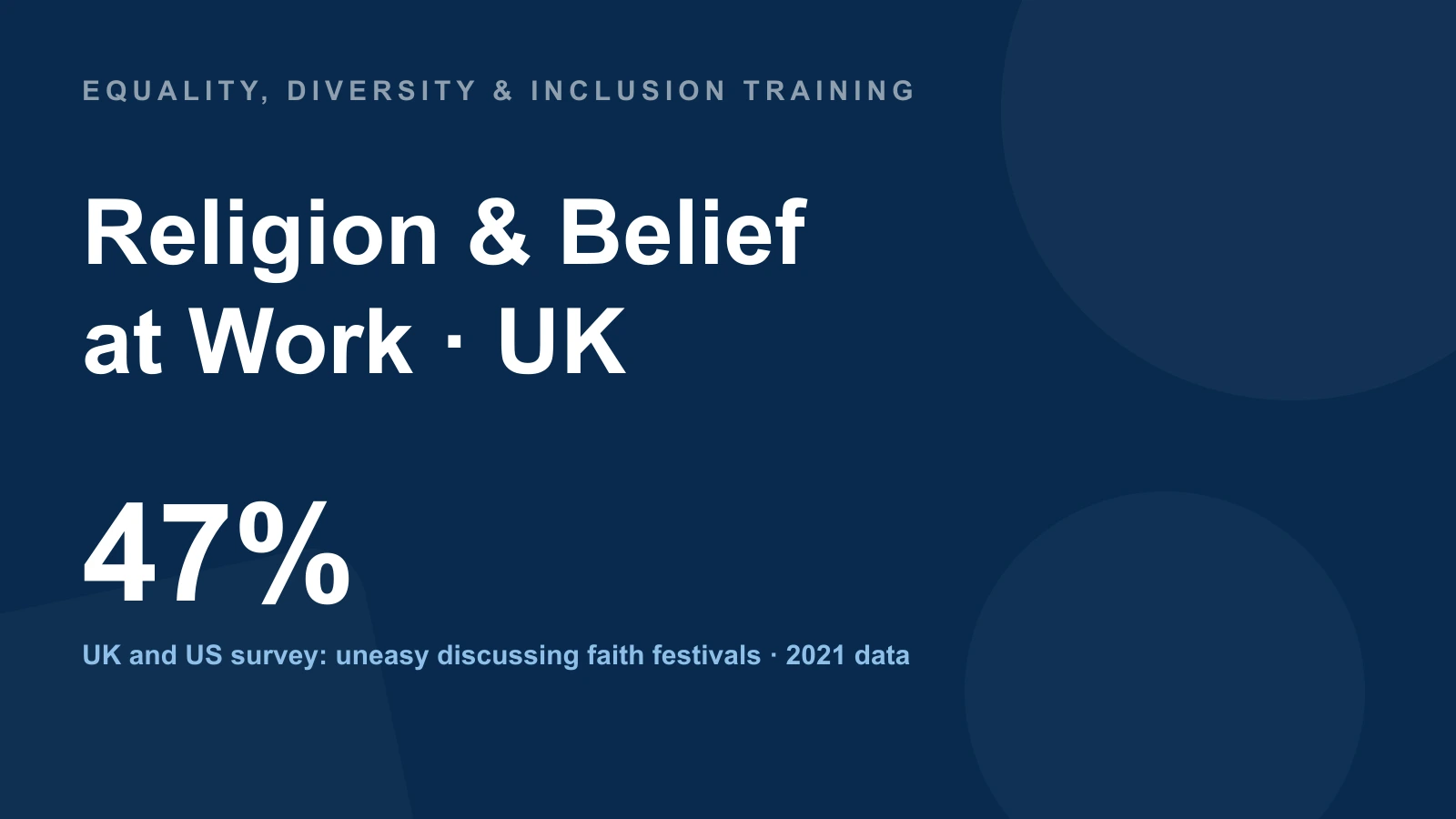
- 47% were uncomfortable discussing religious festivals at work in that combined-country survey.
- 64% of respondents who wore religious dress or symbols at work were uncomfortable doing so; this is a smaller subgroup.
- 19% said religious-holiday leave had been rejected without good business reason, combined UK/US survey.
- 23% of the 3,433 respondents wearing religious dress or symbols outside work also wore them at work.
- 47% / 36% of Jewish / Muslim respondents perceived increased discrimination since 7 October 2023, Pearn Kandola 2024.
- 46.2% of the England and Wales population identified as Christian in Census 2021; 37.2% reported no religion.
- 38% felt their employer could do more to help people feel comfortable wearing religious dress, combined UK/US survey.
Reviewed 15 October 2026. These are survey findings and population statistics with different geographical coverage; none is a single current UK workplace-discrimination rate.
How common is religious discrimination at work in the UK?
There is no single current official prevalence rate for religious discrimination at work. Pearn Kandola’s Religion at Work report, published in 2023, combines 6,315 participants in the UK and US surveyed in 2021 across six faith groups. A separate qualitative follow-up involved 470 participants in 2022.
The headline combined-country findings should not be labelled a UK-only 2023 survey. They describe respondents’ experiences and perceptions rather than tribunal findings. Religion or belief is a protected characteristic under the Equality Act 2010 in Great Britain.
How comfortable are people expressing their religion at work?
Among respondents who wore religious dress or symbols outside work, 23% also did so at work. Among those wearing them at work, 64% felt uncomfortable and 16% comfortable. The 64% therefore does not use all 3,433 external dress-wearers as its denominator.
In the separate qualitative follow-up, negative outcomes formed 32% of coded responses about the impact of religious expression. That is not a prevalence estimate showing 32% of all faith workers suffered backlash. The quantitative survey’s 38% figure specifically concerned doing more to support comfort wearing religious dress.
Employers should consider requests about religious expression individually. A restriction may create indirect discrimination unless objectively justified; a policy’s existence alone does not establish that a restriction is lawful.
Which religious groups are most likely to have holiday requests refused?
In the combined UK/US 2021 survey, 19% said they had felt a request for religious-holiday leave was rejected without good business reason. The table shows respondents’ perceptions by faith, not a verified legal assessment of each refusal or a UK-only ranking.
| Faith group | Reported refusal without good business reason |
|---|---|
| Christian | 2% |
| Buddhist | 14% |
| Jewish | 20% |
| Hindu | 23% |
| Sikh | 25% |
| Muslim | 31% |
Source: Pearn Kandola 2023 report, quantitative fieldwork 2021. Leave needs, opportunities to request leave and sample composition differ. The percentages do not establish a like-for-like probability that an individual request will be refused. Refusing a request is not automatically unlawful; discriminatory treatment and any justification must be assessed on the facts.
Did religious discrimination at work rise after 7 October 2023?
Pearn Kandola’s 2024 report found that 47% of Jewish respondents and 36% of Muslim respondents perceived increased discrimination since 7 October 2023. This is a retrospective survey perception, not a measured national before-and-after incident rate.
The report separately records personal experience of religious discrimination for 39% of Jewish and 24% of Muslim respondents. Those experience figures should not be assigned the “since 7 October” period merely because a later question uses it.
In the follow-up question about action after witnessing or experiencing discrimination, 29% of Jewish respondents and 16% of Muslim respondents selected reporting to HR. Other routes included line managers, colleagues and external organisations. Not reporting to HR is therefore not the same as taking no action. The report is publicly available in the sources below.
What does Census 2021 show about religion in the population?
Census 2021 recorded 46.2% of England and Wales residents as Christian, 37.2% with no religion, 6.5% Muslim and 1.7% Hindu. These are population figures, including children, and must not be described as the composition of the UK workforce.
| Religion, England and Wales | Share, 2021 | People |
|---|---|---|
| Christian | 46.2% | 27.5 million |
| No religion | 37.2% | 22.2 million |
| Muslim | 6.5% | 3.9 million |
| Hindu | 1.7% | 1.0 million |
A separate employer series is available for the Civil Service. At 31 March 2026, among staff with a known religion or belief, 41.0% were Christian, 6.7% Muslim and 44.9% reported no religion. The declaration rate was 73.8%, so these percentages do not describe all staff or all public-sector workers.
What does the Equality Act 2010 say about religion or belief?
Section 10 of the Equality Act 2010 protects religion, qualifying philosophical belief and lack of religion or belief. A philosophical belief must satisfy established legal tests, including seriousness and coherence; every opinion is not automatically protected. Northern Ireland has a separate legal framework.
Protection covers direct and indirect discrimination, harassment and victimisation. Direct religion discrimination is generally unlawful, subject to specific exceptions such as a genuine occupational requirement. Neutral rules disadvantaging a faith group may require objective justification.
Protection for a belief does not give an unrestricted right to manifest it in any way. Restrictions need careful assessment of the circumstances, the rights of others and the applicable legal test.
Frequently asked questions
How common is religious discrimination at work?
Available surveys use different samples and questions. The Pearn Kandola 2023 report combines UK and US participants surveyed in 2021; its percentages are not a current UK-only prevalence rate.
Which groups reported religious-holiday refusals?
In that combined-country survey, 31% of Muslim respondents and 2% of Christian respondents reported a refusal without good business reason. These are perceptions across respondents, not the rejection rate for comparable leave applications.
What did the 2024 study find after 7 October 2023?
Forty-seven per cent of Jewish and 36% of Muslim respondents perceived increased discrimination. This does not establish a national causal trend.
What does the Equality Act protect?
In Great Britain it protects religion, qualifying philosophical belief and lack of belief. Discrimination, harassment and victimisation rules apply, with specific exceptions and justification tests depending on the claim.
How many people are religious?
Census 2021 figures here cover England and Wales, not the whole UK or just workers. Christian identification was 46.2%, no religion 37.2%, Muslim 6.5% and Hindu 1.7%.
Related guides
- Workplace Discrimination Statistics UK: Tribunal Claims, Prevalence & Protected Characteristics
- Ethnicity Pay Gap Statistics UK
- The Nine Protected Characteristics Under the Equality Act 2010
- Equality Act 2010: The Complete UK Guide
- Equality, Diversity and Inclusion: A UK Guide
Sources & references
- Pearn Kandola — Religion at Work 2023; UK/US fieldwork 2021 and 2022
- Pearn Kandola — Antisemitism and Islamophobia at Work 2024
- ONS — Religion, England and Wales: Census 2021
- Cabinet Office — Civil Service statistics, 31 March 2026
- Acas — Religion or belief discrimination
- Equality Act 2010, section 10
Religious-holiday leave, faith-based harassment and religious dress are the recurring risk areas — make sure your team understands religion or belief under the Equality Act 2010 before an issue arises.
Explore the Equality, Diversity & Inclusion course →
Mark writes about equality, diversity and inclusion, UK workplace compliance and accredited online training for Equality, Diversity & Inclusion Training, part of Online CPD Academy.