
This guide brings together evidence on workplace adjustments, Access to Work and disability-discrimination complaints. Each source measures a different part of the process, so the survey population, geography and reporting period are stated with the figures.
Key facts and figures
- 82% of surveyed workers still waiting for all agreed adjustments had waited four months to over a year, TUC 2025.
- 55% of adjustment requesters said their employer agreed only some or none of their requested adjustments, TUC 2025.
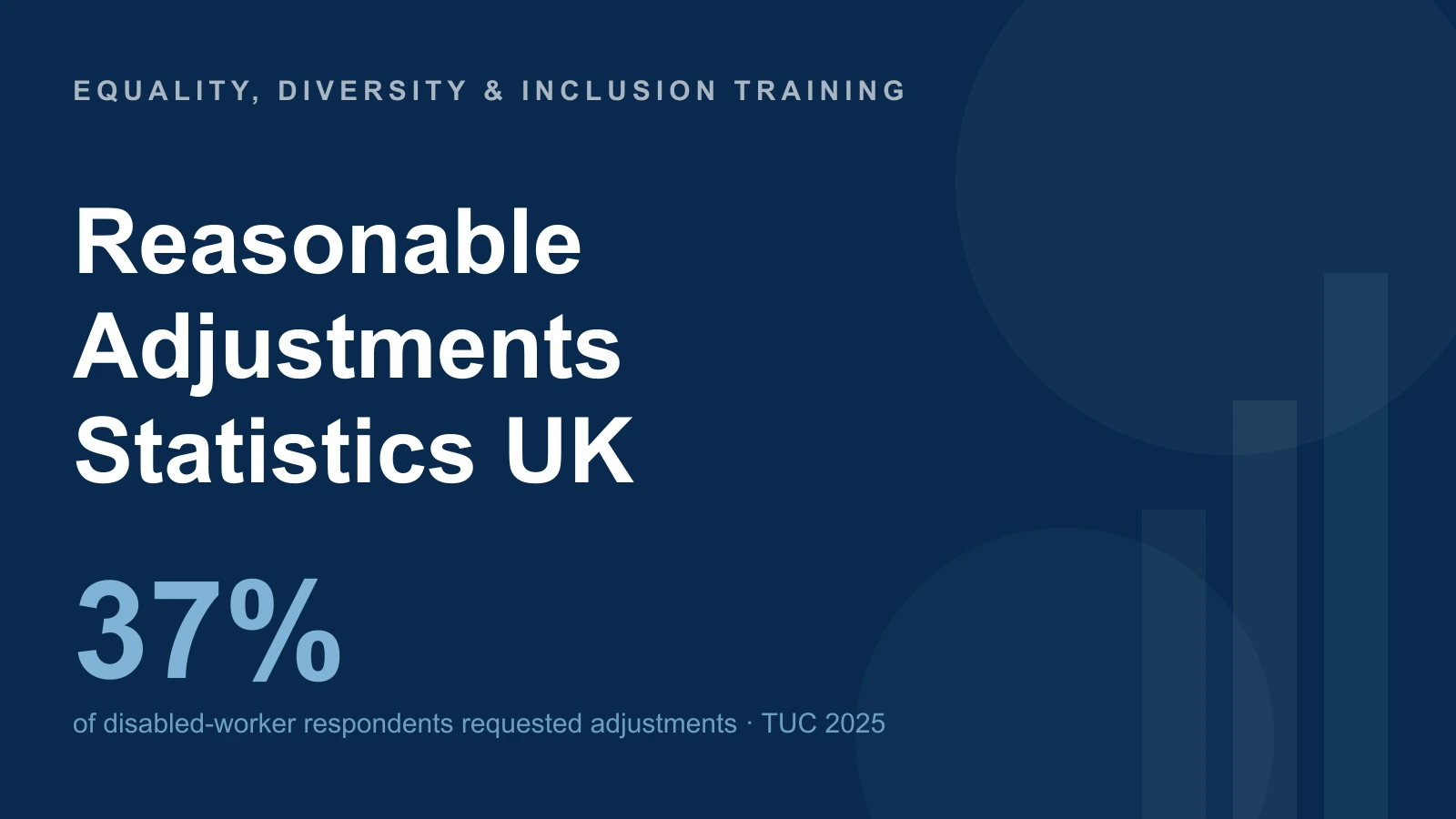
- 37% of the TUC’s 1,000 disabled-worker respondents had requested adjustments, 2025.
- 106 working days average Access to Work processing time reported to the PAC in March 2026.
- About 66,000 Access to Work applications awaited a decision in March 2026, PAC.
- 56,000 people had Access to Work provision approved in Great Britain in 2024/25, down 12%.
- 4,051 disability-discrimination complaints received in Reform single tribunal cases, April–June 2026, provisional.
- £320.7 million Access to Work expenditure in Great Britain in 2024/25, DWP.
Reviewed 15 October 2026. Survey responses, grant applications and tribunal complaints measure different things; their populations and periods are stated separately.
How many disabled workers get the reasonable adjustments they ask for?
The TUC’s May 2025 report surveyed 1,000 disabled workers. Thirty-seven per cent had requested adjustments; among those who had not, 53% said they did not need any. The request rate alone therefore does not measure unmet need.
Among requesters, employers agreed all requested adjustments for 36%, some for 44% and none for 11%; 5% had not heard back. Agreement is different from implementation: among respondents with any agreed adjustments, 45% said all had been implemented.
Twenty per cent had not disclosed their disability; among that group, 56% feared repercussions. Employers should respond when they know, or could reasonably be expected to know, about a disability and relevant disadvantage; a particular form or formal diagnosis is not automatically required.
How long does it take to get reasonable adjustments put in place at work?
The 82% waiting figure concerns respondents whose employer had agreed adjustments but had implemented only some or none. They had been waiting between four months and over a year. It is not the proportion of all disabled workers, nor a measure of completed requests.
The survey also found 34% identified difficulty getting adjustments and 34% identified disability-related leave being counted as sick leave among their workplace issues. These were reported experiences, not findings that every employer had acted unlawfully.
| Survey measure | Figure | Population / period |
|---|---|---|
| Had requested adjustments | 37% | All disabled-worker respondents, TUC 2025 |
| Employer agreed some or none | 55% | Workers who requested adjustments |
| Still waiting four months to over a year | 82% | Those awaiting some or all agreed adjustments |
| No reason given for refusal | 19% | Those with requests partly or wholly refused |
| Told adjustment was impractical | 24% | Those with requests partly or wholly refused; multiple answers |
| Had not disclosed disability | 20% | All respondents |
These results describe the TUC’s 2025 survey, not a continuously updated national series.
What is Access to Work and how much does it fund?
Access to Work is a Great Britain grant scheme for eligible disability-related employment support. Individuals apply; the scheme can provide support beyond an employer’s reasonable-adjustment responsibilities, which remain in place. Northern Ireland operates a separate scheme.
DWP’s revised 2024/25 statistics show provision approved for 56,000 people, down 12% from 63,450. Payments supported 74,190 people during the year. Approval and payment totals differ because support can span more than one year.
Expenditure was £320.7 million in 2024/25. These are the latest published annual figures available at this review; they are not an estimate of all employer spending on adjustments.
What is the Access to Work backlog and how long is the wait?
The Public Accounts Committee’s June 2026 report recorded an average processing time of 109 working days in November 2025. At its March 2026 evidence session, DWP reported 106 working days. Working days must not be presented as calendar days.
About 66,000 applications awaited decisions in March 2026. This was a decision backlog, distinct from claims for payment for support already provided.
| Access to Work measure | Figure | Period / evidence |
|---|---|---|
| Average processing time | 66 working days | 2024/25 |
| Average processing time | 109 working days | November 2025 |
| Average processing time | 106 working days | Reported to PAC, March 2026 |
| Applications awaiting a decision | 21,700 | March 2022 |
| Applications awaiting a decision | 62,100 | March 2025 |
| Applications awaiting a decision | About 66,000 | March 2026 |
Employers should consider and provide reasonable adjustments without assuming that an outstanding grant application suspends their legal duty. What is reasonable depends on the individual circumstances.
How many reasonable adjustment claims reach an employment tribunal?
MoJ recorded 4,051 disability-discrimination jurisdictional complaints received in April–June 2026 in single cases on the Reform system, provisionally. The revised 2025/26 total in that series was 13,246. These are complaints, not unique people or findings of discrimination.
The category includes several forms of disability discrimination. It does not identify how many complaints solely concern reasonable adjustments. The Reform system was introduced in stages, so early figures are not a consistent basis for long-term comparisons.
Discrimination compensation has no statutory upper cap, but depends on the proven claim and loss. The latest MoJ release suspends annual compensation tables while the case-management data are combined. A historical all-disability award should not be described as an average payout for a reasonable-adjustment claim.
Why do these numbers matter for employers?
The TUC survey describes delays and unmet requests, but a survey response does not establish a breach of the Equality Act. Employers should consider the person’s disadvantage, the effectiveness and reasonableness of an adjustment, and implement reasonable steps promptly.
The delivery statistics also expose a structural weakness: employers cannot lean on Access to Work to carry the load. With average processing reported to the PAC in March 2026 at 106 working days and roughly 66,000 applications outstanding, delays can affect access to the scheme. Acas guidance on reasonable adjustments at work is clear that employers should engage with the practical need rather than waiting on external funding or a formal diagnosis. Training managers to handle requests promptly, document decisions and avoid the ‘not practical’ brush-off is the most direct way to keep both the human and the legal cost down — the focus of our own Equality, Diversity & Inclusion Training course.
Frequently asked questions
How many disabled workers get the adjustments they request?
In the TUC’s 2025 survey, 36% of requesters said all requests were agreed. Of those with any agreed adjustments, 45% said all had been implemented. These are different stages and denominators.
How long do workplace adjustments take?
There is no universal survey-derived waiting time. Among TUC respondents still waiting for some or all agreed adjustments, 82% had waited four months to over a year.
What was the Access to Work backlog?
The PAC reported about 66,000 applications awaiting decisions in March 2026. DWP reported average processing of 106 working days at that month’s evidence session.
How many disability complaints reached tribunals?
The provisional April–June 2026 total was 4,051 jurisdictional complaints in Reform single cases. The figure is broader than reasonable-adjustment claims and is not a count of successful cases.
Is there a standard payout for an adjustment claim?
No. Compensation depends on the facts and proven losses. Discrimination awards have no statutory upper cap, and published disability-award figures cover more than adjustment claims.
Related guides
- Disability Employment Gap Statistics UK: Rates, Pay Gap & Trends
- Workplace Discrimination Statistics UK: Tribunal Claims, Prevalence & Protected Characteristics
- Neurodiversity Statistics UK: Autism, ADHD & Dyslexia Prevalence and Employment
- Reasonable Adjustments Under the Equality Act 2010: A UK Employer’s Guide
- Equality Act 2010: The Complete UK Guide
Sources & references
- TUC — Disabled workers’ access to reasonable adjustment, May 2025
- DWP — Access to Work statistics to March 2025, revised January 2026
- Public Accounts Committee — The Access to Work scheme, June 2026
- MoJ — Tribunal statistics, April to June 2026, table ET_1_R
- Acas — Reasonable adjustments at work
Train your managers to handle adjustment requests promptly and lawfully — before delay turns into a tribunal claim.
Explore the Equality, Diversity & Inclusion course →
Mark writes about equality, diversity and inclusion, UK workplace compliance and accredited online training for Equality, Diversity & Inclusion Training, part of Online CPD Academy.