
This guide covers evidence about the recruitment process: historical field experiments, current employer-practice surveys and regulatory findings about AI tools. The figures describe different samples and periods, rather than a single national rate of hiring bias.
Key facts and figures
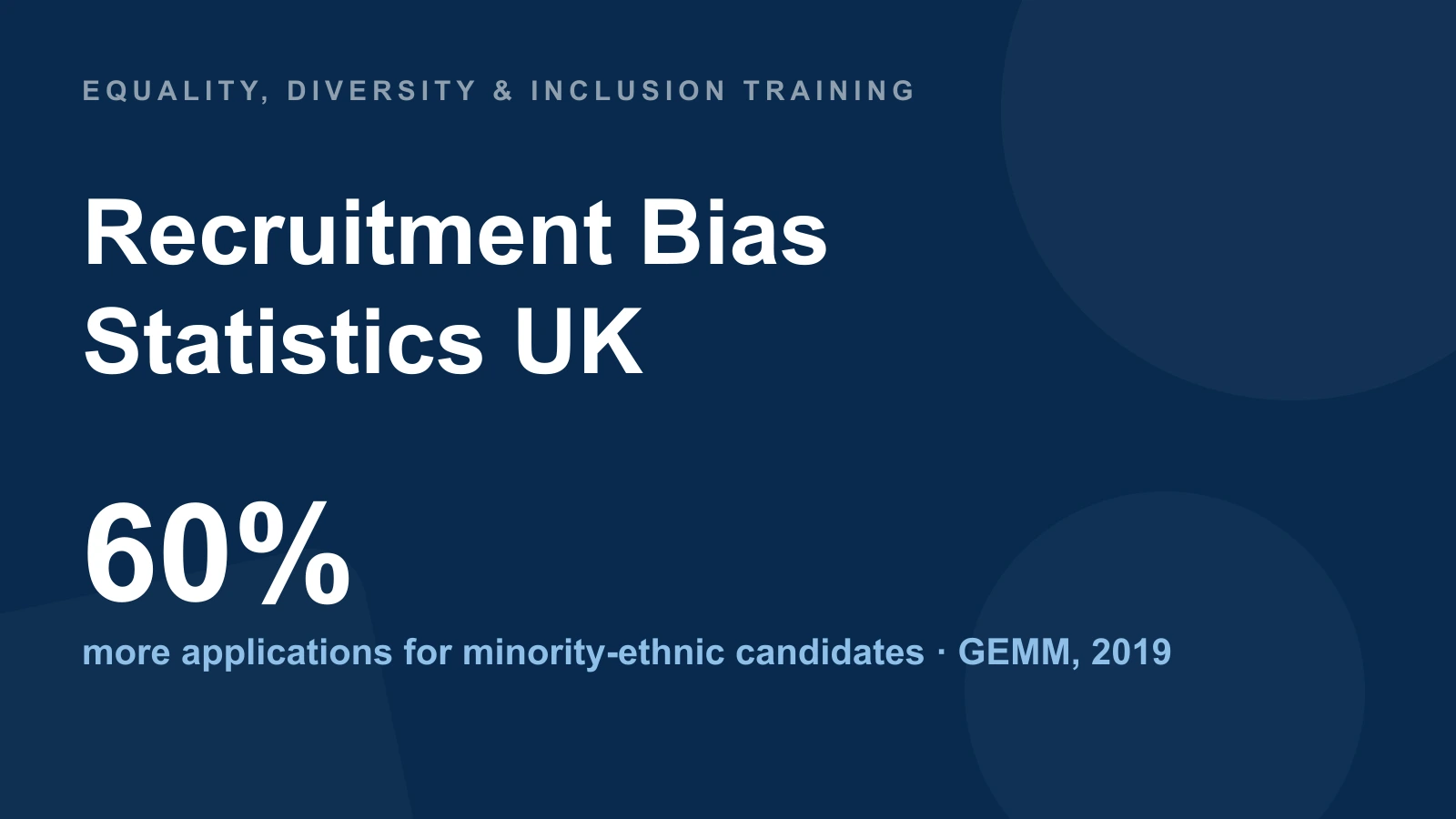
- 60% more applications were needed for a positive response by minority-ethnic applicants in the historical GEMM Britain experiment, published 2019.
- Nearly 3,200 real vacancies were tested in that experiment; this is a study sample, not all UK recruitment.
- Almost 300 recommendations arose from the ICO’s 2024 audits of AI recruitment providers.
- 19% of organisations surveyed by CIPD in 2026 removed selected biographical details at initial selection.
- 26% reported using a diverse interview panel or hiring team, CIPD 2026.
- 25% trained all interviewers in legal obligations and objective interview practice, CIPD 2026.
- 9,022 applications in a separate UK CV-format field experiment published in 2023.
- About 8% relative callback improvement for experience-focused CVs versus date-based CVs without gaps in that experiment.
Reviewed 15 October 2026. Historical experiments test specific recruitment settings; the current CIPD survey describes reported employer practices, not the effectiveness of each method.
Do UK employers discriminate based on the name on a CV?
The GEMM correspondence experiment in Britain, conducted in 2016–2018 and published in January 2019, sent fictitious applications to nearly 3,200 real vacancies. Qualifications and skills were designed to suit the jobs, while ethnic background was varied randomly. The design tested ethnicity signals; it should not be reduced to a claim that only the name changed in every application.
Nuffield reported that minority-ethnic applicants needed 60% more applications for the same positive response as White British applicants. A response was an invitation or request for contact, not a job offer. The finding is historical evidence from selected occupations rather than a measured 2026 national rate.
The authors also compared earlier British field experiments and found persistent disadvantage for Black British and Pakistani-background applicants. Differences between study designs limit exact comparisons across the whole period.
Recruitment measures at a glance
The GEMM headline remains 60% more applications in its historical sample. For a current view of employer practice, CIPD’s 2026 survey of 1,014 respondents reports the following approaches. These percentages do not estimate an applicant’s chance of being hired.
| Recruitment practice | Organisations reporting use | Source / period |
|---|---|---|
| Diverse interview panel or hiring team | 26% | CIPD 2026, figure 17 |
| Training all interviewers on legal and objective practice | 25% | CIPD 2026, figure 17 |
| Adjusting selection for disability, neurodivergence or long-term conditions | 22% | CIPD 2026, figure 17 |
| Removing selected biographical details at initial selection | 19% | CIPD 2026, figure 17 |
The anonymisation question includes names, gender, age and university. It is not identical to a name-blind-CV-only question, so it should not be used to manufacture a trend from differently defined older surveys.
Does name-blind recruitment actually reduce hiring bias?
Removing identifying details can reduce some opportunities for bias at an initial sift, but it does not guarantee fair outcomes through interviews, offers and progression. CIPD recommends combining it with job-related criteria, structured assessment, reasonable adjustments and monitoring of outcomes.
A separate UK field experiment, published in 2023, tested 9,022 applications. Presenting previous work as years of experience rather than employment dates increased callbacks by approximately 8% relative to date-based CVs without employment gaps. This tested CV presentation, not the effect of name-blind hiring on ethnic-minority recruitment.
CIPD’s 2026 survey found 19% removed selected biographical details. This measures reported practice and does not establish the causal effect of anonymisation on hiring outcomes.
How common are discriminatory interview questions?
Interviewers should assess evidence against the role’s criteria consistently. Questions about protected characteristics can create opportunities for discrimination, but there is no verified national percentage here for how many jobseekers face unlawful questions.
Section 60 of the Equality Act 2010 restricts health and disability questions before an offer, with specified exceptions such as arranging adjustments for the recruitment assessment. Asking a permitted question does not authorise discriminatory use of the answer. Equality monitoring should be separated from selection decisions.
CIPD’s 2026 survey found 25% trained all interviewers on legal obligations and objective practice, while 22% determined job-related selection criteria and methods in advance. These are reported practices, not findings that every other employer breached the law.
Is AI recruitment software making hiring bias better or worse?
The ICO’s November 2024 audit programme produced almost 300 recommendations for AI recruitment providers. Its findings included tools allowing filtering by protected characteristics, inferring gender or ethnicity from names, and collecting or keeping excessive personal information.
This was an audit programme covering participating providers, not a prevalence survey of every AI recruitment tool. The ICO subsequently reported following up and confirming implementation of its recommendations.
Recruiters should assess fairness, data quality and privacy, explain how candidates’ information is used, and monitor the tool in its actual setting. Using a supplier or an automated score does not remove the organisation’s legal responsibilities.
What does international evidence add?
King’s College London’s Resume Bias project reports an Australian experiment involving over 12,000 applications to more than 4,000 advertisements. For leadership roles, English-named applicants received positive responses on 26.8% of applications versus 11.3% for non-English-named applicants.
These are Australian findings, not UK statistics. They add evidence that recruitment context and seniority matter, but cannot establish the size of a current British hiring gap.
Frequently asked questions
Does a name affect recruitment outcomes?
British field experiments have found different employer responses to matched applications with different ethnicity signals. The GEMM study, published in 2019, found minority-ethnic applicants needed 60% more applications for a positive response.
Is the 60% figure a current national rate?
No. It describes the historical GEMM experiment in selected British vacancies, not every employer or the 2026 labour market.
Does name-blind recruitment guarantee fair hiring?
No. It can limit some identifying cues at the first stage, but should be combined with structured selection and monitoring. CIPD’s 2026 survey found 19% removed selected biographical details.
What did the ICO find about AI recruitment?
Its 2024 audits produced almost 300 recommendations, including on fairness, accuracy, transparency and data minimisation. The results describe audited providers rather than all recruitment software.
What does the Equality Act say?
Discriminatory selection can breach the Act in Great Britain. Section 60 also restricts pre-offer health and disability questions, with specific exceptions. Reasonable adjustments may be needed for the assessment process.
Related guides
- Workplace Discrimination Statistics UK: Tribunal Claims, Prevalence & Protected Characteristics
- Ethnicity Pay Gap Statistics UK: The Latest Data by Group
- Disability Employment Gap Statistics UK
- Equality Act 2010: The Complete UK Guide
- The Nine Protected Characteristics Under the Equality Act 2010
Sources & references
- Nuffield College — GEMM field experiment, published January 2019
- British Academy — Historical field-experiment evidence, January 2019
- CIPD — Resourcing and talent planning 2026, figure 17
- ICO — AI recruitment audit findings, November 2024
- Kristal and colleagues — Reducing discrimination against job seekers with and without employment gaps, 2023
- King’s College London — Resume Bias project, Australian study
- Equality Act 2010, section 60: pre-employment health questions
- CIPD — Inclusive recruitment guide
The bias measured in these studies happens at the very first sift — train your hiring managers on the Equality Act 2010 and fair, structured recruitment.
Explore the Equality, Diversity & Inclusion course →
Mark writes about equality, diversity and inclusion, UK workplace compliance and accredited online training for Equality, Diversity & Inclusion Training, part of Online CPD Academy.