
This guide distinguishes ONS estimates of sexual orientation in the adult population from research about LGBT+ experiences at work. Survey samples, dates and geographical coverage are stated alongside the findings. Reviewed 15 October 2026.
Key facts and figures
- 3.7% of the UK household population aged 16+ identified as lesbian, gay or bisexual in 2024: around 2.0 million, ONS.
- 8.0% of ages 16–24 identified as LGB in 2024, compared with 1.2% of ages 65+, ONS.
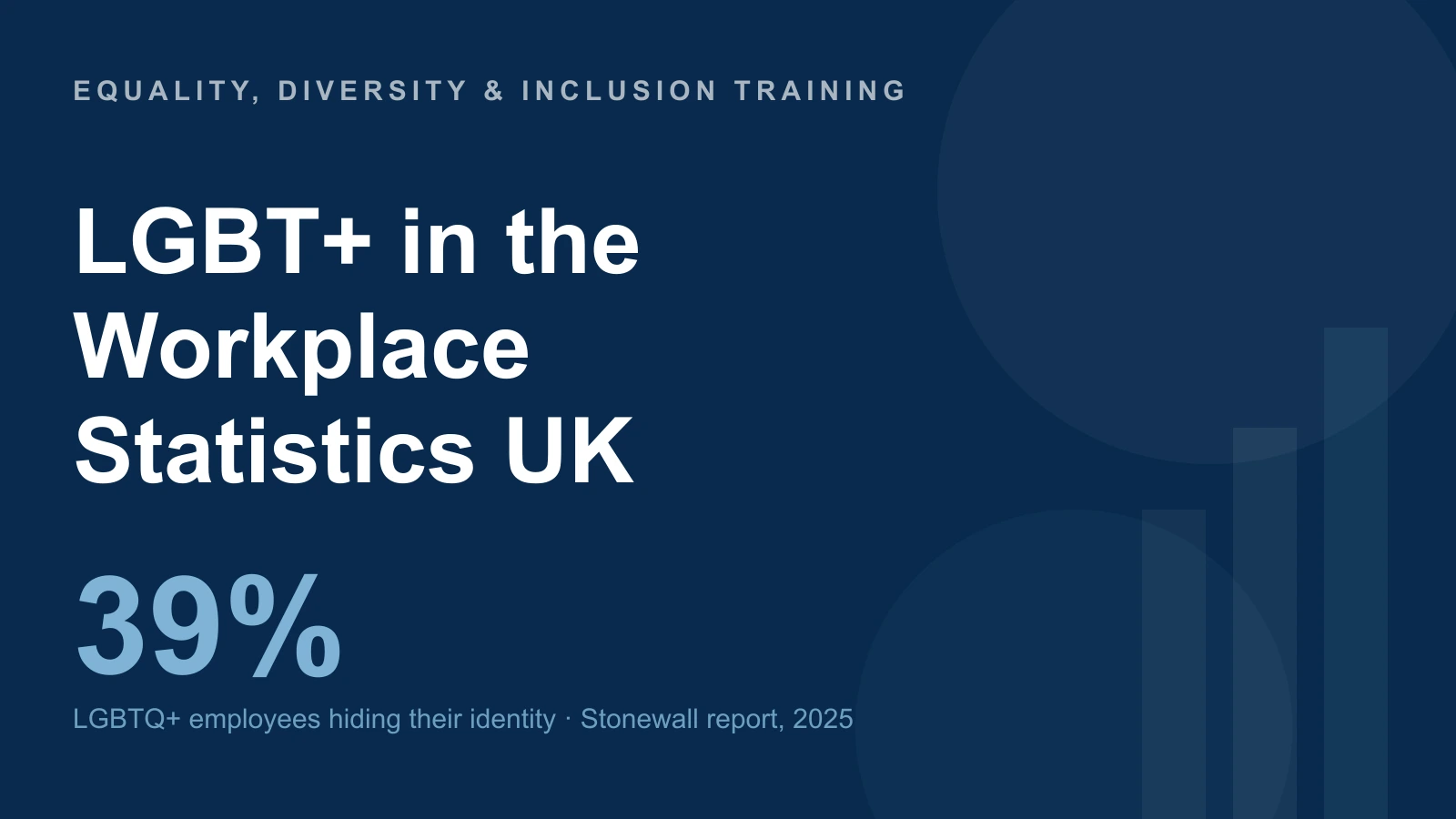
- 39% of LGBTQ+ employee respondents felt a need to hide their identity at work, Stonewall research published January 2025.
- 31% did not agree they could be themselves at work in the same Stonewall research.
- 33% reported a negative career impact in Randstad’s 2024 survey across seven countries, including the UK; not a UK-only result.
- 55% of trans respondents reported workplace conflict over 12 months in CIPD’s 2021 research, compared with over 40% of LGB+ workers.
- 16% and 18% of LGB+ and trans respondents respectively felt psychologically unsafe, compared with 10% of heterosexual workers, CIPD 2021.
- 52% of LGBT+ respondents reported at least one listed form of workplace mistreatment in the preceding five years, TUC survey 2023.
Reviewed 15 October 2026. Official adult-population estimates are separate from workplace surveys, whose dates, samples and country coverage differ.
How many people in the UK are LGBT+?
ONS estimated that 3.7% of the UK household population aged 16+ identified as lesbian, gay or bisexual in 2024, around 2.0 million people, compared with 2.7% in 2019. This is an adult-population estimate, not the percentage of employees who are LGBT+.
The 2024 total includes 2.1% identifying as gay or lesbian, around 1.2 million, and 1.6% as bisexual, around 855, 000. The Annual Population Survey estimates are official statistics in development and carry increased uncertainty from lower response rates. They measure sexual orientation, not a combined count of all LGBT+ identities.
LGB identification was 8.0% at ages 16–24 and 1.2% at 65+. Among ages 25–34 it increased from 3.6% in 2019 to 6.4% in 2024. Age differences do not by themselves establish how future workforce shares will change.
How many LGBT+ workers hide their identity at work?
Stonewall’s research published on 31 January 2025 found 39% of LGBTQ+ employee respondents felt a need to hide their identity at work and 31% did not agree they could be themselves.
Stonewall also reported that 36% of employees had heard discriminatory comments about an LGBTQ+ colleague and 12% of LGBTQ+ respondents believed they had been dismissed because of their identity. These are reported experiences and beliefs, not findings that each dismissal was unlawful.
In CIPD’s separate 2021 research, 26% of 193 trans respondents were not open about their gender identity at all at work and 39% were mostly or completely open. The sample included non-binary respondents. Disclosure remains an individual choice.
Does being LGBT+ affect career and pay?
Randstad’s 2024 survey collected responses from 2, 361 LGBTQI+ people in the UK, US, Australia, Japan, France, the Netherlands and Germany between 15 April and 3 May. Across those seven markets, 33% reported a negative impact on their career and 35% on remuneration or progression. These pooled percentages should not be labelled UK rates.
The same international survey found 41% reporting discrimination or prejudice and 29% saying they had left a job over discrimination concerns. The results describe respondents’ experiences; they do not quantify a current national LGBT+ pay gap.
| Measure | Figure | Source and scope |
|---|---|---|
| Negative career impact | 33% | Randstad, seven markets, 2024 |
| Negative pay or progression impact | 35% | Randstad, seven markets, 2024 |
| Experienced discrimination or prejudice | 41% | Randstad, seven markets, 2024 |
| Left a job over discrimination concerns | 29% | Randstad, seven markets, 2024 |
| Did not agree they could be themselves at work | 31% | Stonewall UK research, published 2025 |
These measures should not be converted into an annual pay-loss amount. There is no general mandatory LGBT+ pay-gap reporting requirement equivalent to the gender pay-gap reporting framework.
How safe do LGBT+ employees feel at work?
CIPD’s report published in February 2021 found 16% of LGB+ respondents felt psychologically unsafe at work, compared with 10% of heterosexual respondents; the separate trans survey found 18%. Psychological safety concerns being accepted, valued and able to raise concerns.
Over 40% of LGB+ workers reported conflict over 12 months, compared with 29% of heterosexual workers. The trans survey found 55%. The report combines UK Working Lives data with a separate 193-person trans sample, so differences should not be treated as a controlled comparison of otherwise identical groups.
Do trans employees face more barriers than LGB colleagues?
The CIPD research identifies particular difficulties among trans respondents, including conflict and openness about identity. It does not establish that every trans person experiences worse outcomes on every measure or that sexual orientation and gender identity are mutually exclusive groups.
In Great Britain, Equality Act gender-reassignment protection covers someone proposing to undergo, undergoing or having undergone a process of reassigning sex by changing physiological or other attributes of sex. Medical treatment or a Gender Recognition Certificate is not required. Whether a particular non-binary person meets that definition depends on the circumstances; other applicable protections also remain available.
The Supreme Court’s April 2025 judgment held that sex in the Act means biological sex while confirming protection for trans people under gender reassignment and other applicable provisions. Northern Ireland has a separate equality-law framework.
How much harassment do LGBT+ workers face?
The TUC’s July 2025 analysis uses a survey conducted between May and November 2023 among 1, 001 LGBT+ adults in Great Britain who had worked within the previous five years. Fifty-two per cent reported at least one listed form of bullying, discrimination or harassment during that five-year period.
This is a combined mistreatment measure, not a sexual-harassment-only rate or the percentage affected in 2025. The different behaviours and time periods used by surveys mean their percentages cannot be directly ranked. Our sexual harassment statistics explain those distinctions.
What do the numbers mean for UK employers?
The evidence supports checking employees’ experiences rather than assuming that written policies establish an inclusive workplace. Survey dates and methods matter: a population estimate, an international poll and a small specialist sample answer different questions.
Clear reporting routes, fair investigation, confidentiality and protection against victimisation can support employees. These practices should reflect the applicable equality duties and individual circumstances, without requiring staff to disclose personal information unnecessarily.
Frequently asked questions
What percentage of UK employees are LGBT+?
The cited ONS figure is 3.7% of the UK household population aged 16+ identifying as LGB in 2024. It is not an employee-only estimate or a count of all LGBT+ identities.
How many workers hide their identity?
Stonewall research published in January 2025 found 39% of LGBTQ+ employee respondents felt a need to hide it. CIPD’s separate 2021 trans survey found 26% were not open at all.
Is there a current official LGBT+ pay-gap figure here?
No. Randstad’s 35% measures reported negative effects on pay or progression across seven countries in 2024; it is not a percentage earnings gap.
Do trans employees face barriers?
The CIPD report identifies conflict and psychological-safety concerns among trans respondents, but its separate samples do not establish a universal ranking of every group’s experiences.
Where do these statistics come from?
ONS supplies household-population estimates. Stonewall, CIPD, Randstad and the TUC provide different workplace surveys, with their publication dates, fieldwork and geographic scope stated above.
Related guides
- Sexual Harassment at Work Statistics UK: Prevalence, Reporting Rates & the New Preventative Duty
- Disability Employment Gap Statistics UK
- Ethnicity Pay Gap Statistics UK
- Women in Leadership Statistics UK
- Equality Act 2010: The Complete UK Guide
Sources & references
- ONS — Sexual orientation, UK: 2024, published December 2025
- Stonewall — Workplace research published 31 January 2025
- CIPD — Inclusion at work: perspectives on LGBT+ working lives, 2021
- Randstad — Seven-market LGBTQI+ survey, April–May 2024
- TUC — July 2025 analysis of 2023 LGBT+ worker survey
- Equality Act 2010, section 7: gender reassignment
- Supreme Court — For Women Scotland, April 2025 judgment
An inclusive workplace for LGBT+ colleagues starts with a team that understands the Equality Act 2010 and their everyday responsibilities under it.
Explore the Equality, Diversity & Inclusion course →
Mark writes about equality, diversity and inclusion, UK workplace compliance and accredited online training for Equality, Diversity & Inclusion Training, part of Online CPD Academy.